

Pear farming in South Africa
Learn about pear farming in South Africa, one of the most important deciduous fruits grown in the country in terms of foreign exchange earnings and job creation.
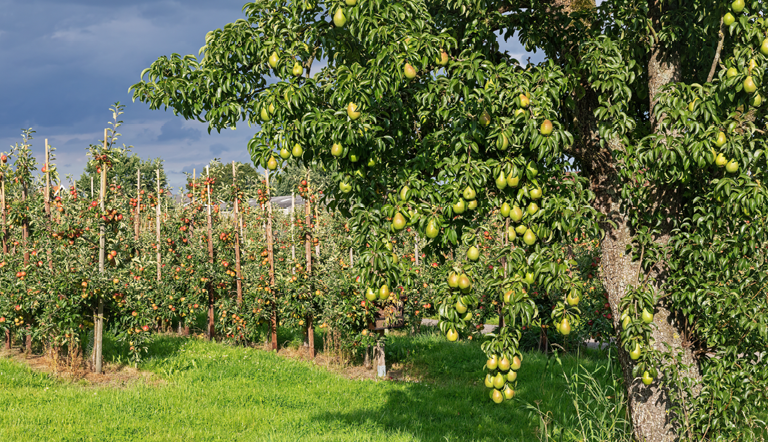
Pears are mainly grown in the Western Cape, and, to a lesser extent, the other provinces.
The fruit is consumed fresh, canned, in juices or dried. The juice is used in jellies and jams, often combined with other fruits or berries.
Pears are one of South Africa’s most important fruits, contributing to foreign currency earnings and the creation of employment.
Pear trees – which are woody trees and shrubs in the genus Pyrus, and which include many species - evolved from the mountains of western China, more than twenty five million years ago. They were introduced to South Africa by the Dutch East India Company, around 1656. Food gardens, including pear trees were cultivated to provide passing ships with provisions. The conditions of the Cape were good to grow pear trees but it was only in the late 1800s that the commercial pear industry began to take shape. The development coincided with the advent of refrigerated shipping, making it possible for fresh fruits to reach England.
Pear trees grow best in temperate zones – areas which experience cold winters and moderate summers. The Western Cape, for this reason, produces more than half of all the pears grown in South Africa. They are a summer fruit and the harvesting depends on the variety of pear and the climatic conditions under which they are grown.
Pear production in South Africa
The main pear producing area in the Western Cape is Ceres; followed by Elgin-Grabouw-Vyeboom-Villiersdorp and then the Langkloof and Wolseley/Tulbagh. While pears are grown in other areas, their overall contribution to the total hectares planted to pears is only about 12 %. The total area on which pears are planted has remained fairly consistent in recent years: It was 12 279 hectares in 2016 and 12 743 in 2021.
The export of pears from South Africa is wide-ranging and growing. While the United Kingdom, continental Europe and Russia are significant markets, there is growth in other regions such as Africa, Asia and the Middle East. More recently, South African pears gained market access in China (late 2021) and India approved in-transit cold treatment for South African pears.
During the second half of 2022, South Africa’s agricultural exports rose by 5% year on year with pears, as one of the top exportable products, expected to dominate going forward. This performance was largely due to a substantial agricultural output in the 2021/2022 production season and solid global demand.
South African pear varieties
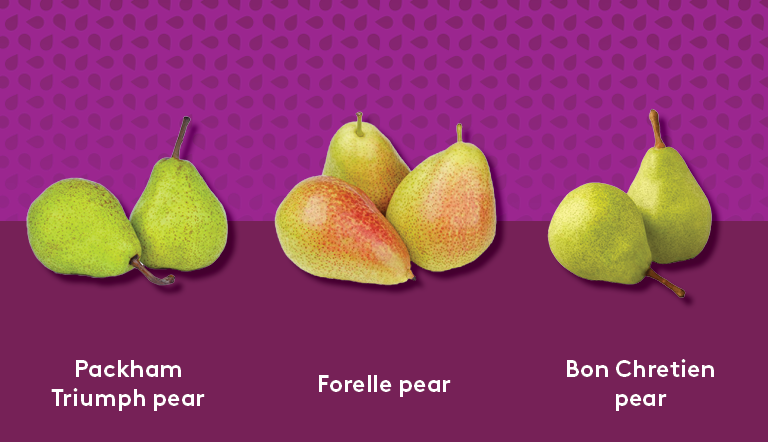
There are numerous kinds of pears grown in the country, including the Packham Triumph pear, originally from Australia, the Forelle pear, a German variety and the Bon Chretien pear, originating from England.
More recently, the new locally bred Rosy-Lwazi Cape Blush pear made an appearance. It can take up to 30 years to cultivate a new pear variety and the Rosy-Lwazi project began in 1995.
The Agricultural Research Council has several pear breeding programs which produced the Rosemary Pear in 1990, the Flamingo Pear in 1993 and the Cheeky pair in 2009. The new Rosy-Lwazi pear is the earliest South African-grown blush pear available to the international market. It brings in good foreign currency.
Outlook
Following a series of unfavourable weather events, including hail and floods, Hortgro, the body which supports deciduous fruit producers in South Africa, estimated a pear export forecast of 17.195 million cartons for the 2023 season. This indicated a decrease of 19 percent, with 4 million fewer cartons than the previous season.
However, in spite of this decline in pear exports, there has been a “countertrend” increase in pear exports to China. South Africa delivered its first shipment of pears to China in August 2022 and export volumes of pears quadrupled the following year. The main varieties of pears exported from South Africa to China are Forelle (which enjoys the largest export volume), Cheeky, Packham’s Triumph, Abate Fetel and Celina. Exports of pears to Hong Kong increased by 60 percent. Today, due to advanced controlled atmosphere technologies and cold storage systems, pears can be exported throughout the year. With growing markets such as these, the stage is set for enhanced export opportunities for South African pears.
Control of pests and diseases in pears
Pear growers and the pear production industry need to contend with a variety of different pests and diseases.
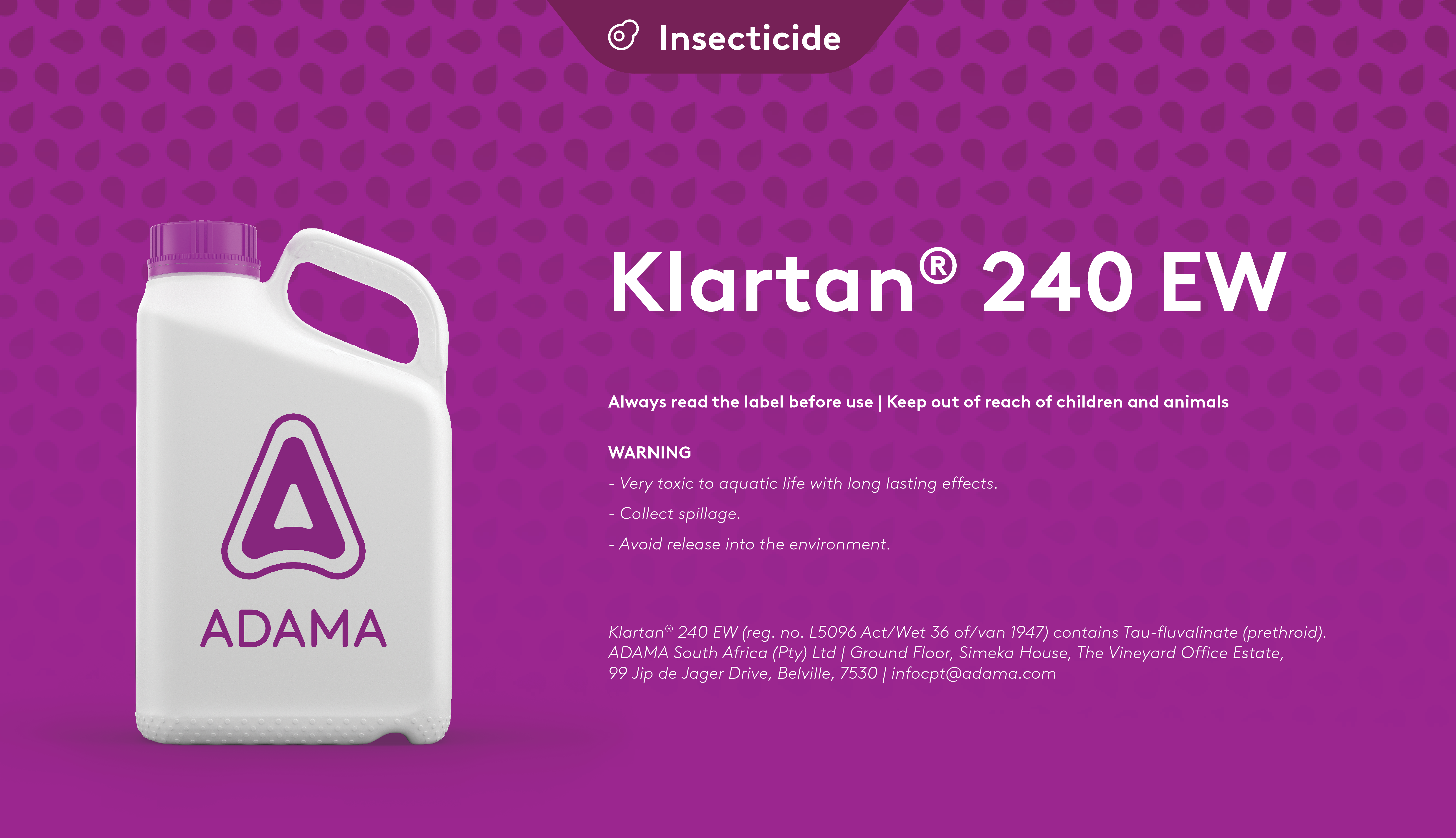
For Antestia bug, fruit nibbler, American bollworm and codling moth: Klartan® 240 EW (Reg. no. L5096 Act/Wet 36 of/van 1947) is a stomach and contact insecticide emulsion (Group 3A). The active ingredient is tau-fluvalinate (pyrethroid) at 240 g/L. It is very toxic to aquatic life with long lasting effects – users should avoid release into the environment and collect spillage. It comes with the warning that it could be harmful when inhaled, swallowed or absorbed through the skin, and requires a re-entry interval of one day after application unless wearing protective clothing. Precautions include avoiding contact with eyes and skin, wearing rubber gloves and a face shield during mixing and application, avoiding inhalation of spray mist, and not smoking, drinking or eating during handling. Always read the label before use.
For Mediterranean fruit fly and Natal fruit fly: Devipan™ 100 (Reg. no. L4669 Act/Wet 36 of/van 1947) is an emulsifiable concentrate insecticide with a strong knock-down effect and short residual action for the control of a variety of pests as listed on the label. The active ingredient is dichlorvos (organophosphate). It is registered for the control in pear farming of Mediterranean fruit fly (Ceratitis capitata) and Natal fruit fly (Ceratitis rosa). It has a danger warning as it is a flammable – liquid and vapour, toxic if swallowed and may be fatal if swallowed or inhaled and enters airways (aspiration hazard) and fatal in contact with skin. It causes skin irritation, allergic skin reaction, and serious eye damage. It is suspected of causing cancer and is very toxic to aquatic life. Keep away from heat, hot surfaces, sparks, open flames, and other ignition sources. Do not smoke when working with it and wear protective gloves, eye, and face protection. Always read the label before use.
For Antestia bug, fruit nibbler, American bollworm and codling moth: Klartan® 240 EW (Reg. no. L5096 Act/Wet 36 of/van 1947) is a stomach and contact insecticide emulsion for the control of the following pests in pears: Antestia bug (Antestiopsis orbitalis), fruit nibbler (Prasoidea sericea), American bollworm (Helicoverpa armigera) and codling moth (Cydia pomonella). The active ingredient is tau-fluvalinate (pyrethroid). It comes with a warning as it is very toxic to aquatic life with long lasting effects. Avoid release to the environment and collect spillage. Always read the label before use.
For more information on any of these products, contact:
ADAMA South Africa (Pty) Ltd
Reg. no. 1992/001741/07
Ground Floor, Simeka House,
The Vineyard Office Estate,
99 Jip de Jager Drive,
Belville, 7530
infocpt@adama.com