

Red spider mite in tomatoes in South Africa
Identifying, monitoring and controlling red spider mite in tomatoes in South Africa
Red spider mite (Tetranychus spp.) is one of the most economically damaging arthropod pests affecting tomato production in South Africa, and a persistent threat to both open-field and greenhouse crops.
The red spider mite thrives in hot, dry weather with low relative humidity – conditions common across much of South Africa’s tomato-growing belt for extended periods. Greenhouse operations are particularly vulnerable, as elevated temperatures and reduced humidity accelerate mite reproduction.
Two species of red spider mite are of primary concern. The two-spotted spider mite (Tetranychus urticae) is the most widespread and economically significant. The tomato red spider mite (Tetranychus evansi) is a more host-specific threat to tomato and other Solanaceae – including capsicum, chillies, eggplant, potato and tobacco. Both species reproduce rapidly under optimal conditions and a population that begins as a few scattered individuals can reach economically damaging levels within days rather than weeks.
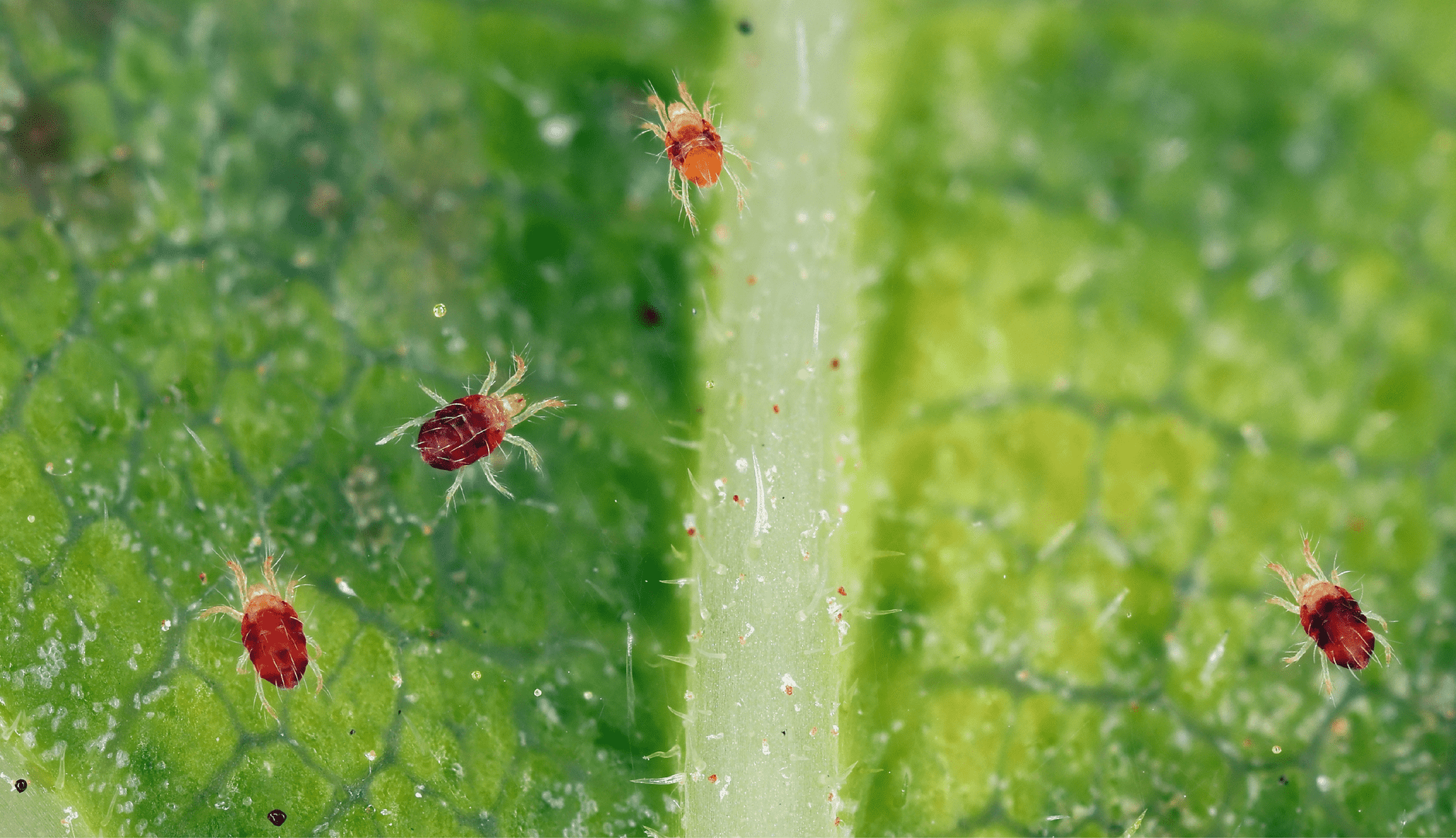
How to identify red spider mite
Red spider mites are extremely small. Adult females measure approximately 0.5mm; males are smaller at roughly 0.3mm. They are difficult to see with the naked eye and are best observed using a 10x hand lens or microscope.
Physical characteristics
- Teardrop or oval-shaped body covered in fine, pale hairs
- Eight legs in the adult and nymph stages; six legs in the larval stage
- Colouration ranges from reddish-brown and orange red to green, yellow or orange
- Males are smaller and yellower than females
- Eggs are round, approximately 0.1mm, orange to white, turning grey before hatching
Signs on the plant
- Pale yellow or whitish speckles on the upper leaf surface – typically the first visible sign, caused by mites piercing cells and extracting sap from beneath
- Progressive yellowing, browning, curling, wilting and premature leaf drop
- Fine silk webbing on the undersides of leaves, particularly along the veins
- Small, mobile red or orange-red dots visible on the leaf underside in heavier infestations
- Mites congregating at the top of the plant when populations are large and sap is depleted
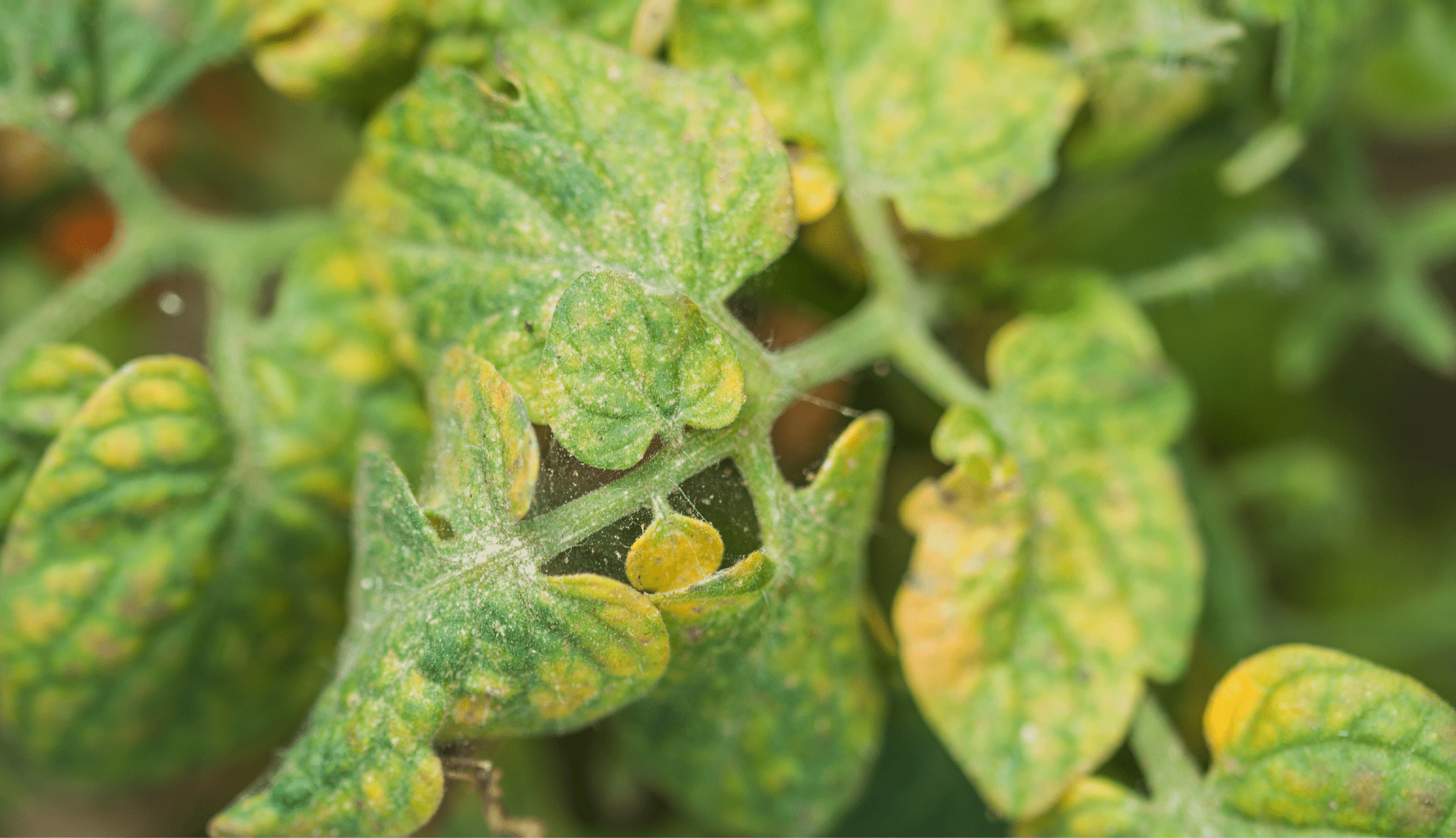
Damage caused by red spider mite
Red spider mites feed by piercing plant cells with needle-like mouthparts and extracting the cell contents, primarily chlorophyll. This feeding disrupts photosynthesis, stunts growth and reduces yield.
- Damage progresses through distinct stages:
Early stage – Individual cells are emptied, producing small, pale dots on the upper leaf surface. Speckling is most visible around the midrib and main veins. - Intermediate stage – Speckles coalesce, giving patches of the leaf a whitish or silvery-transparent appearance. General yellowing develops.
- Advanced stage – Leaves turn brown, curl, wilt and abscise. Fine webbing covers leaves, twigs and sometimes fruit. The plant weakens progressively as sap is removed.
- Severe infestation – Copious webbing binds young leaves together, preventing expansion. The host plant may die within three to five weeks of infestation if untreated.
Water-stressed plants are significantly more susceptible. When a tomato crop is already under moisture stress, mite damage compounds the physiological burden and accelerates decline.
Life cycle of red spider mite
The red spider mite life cycle consists of four stages: eggs, larva, nymph and adult. Females deposit tiny round eggs on the undersides of leaves, twigs or bark. A single female may lay between 100 and 200 eggs over her lifetime, depending on species and conditions.
Eggs hatch in as few as three days under warm conditions, extending to 15 days when temperatures are lower. The six-legged larva is almost colourless with bright red eyes.
The larva moults into a protonymph and then a deutonymph, both bearing eight legs. Nymphs are orange to dark red and resemble smaller versions of the adults.
Following a final moult, the adult mites emerge. Females live for approximately four weeks and begin oviposition shortly after emergence.
Temperature is the primary driver of developmental rate. The complete cycle can be as short as five to 10 days under optimal conditions. Population growth accelerates sharply above 30°C and below 60% relative humidity. The hotter and drier the environment, the shorter the generation time and the faster red spider mite populations expand.
Spider mites are also sensitive to day length and are capable of hibernating within cracks and crevices in plant structures. Infestations in one season are a strong indicator of recurrence in the following season.
Spread
Short distance spread occurs via wind, water splash, dust, clothing and equipment. When populations are dense, mites migrate to the upper portions of the plant to facilitate wind dispersal. Long-distance spread results from the movement of infested plants, seedlings and fruit, including tomatoes sold on the vine.
How to manage red spider mite
Sound management depends on three principles: regular monitoring, early intervention and the use of multiple control methods in combination. No single approach is sufficient on its own.
Inspect crops at least weekly during the growing season, increasing frequency during hot, dry periods. Focus inspection on the undersides of leaves, particularly on the upper portions of the plant where mites tend to establish first. Early detection is the single most important factor in successful control.
ADAMA’s solutions for the control of red spider mite in tomatoes
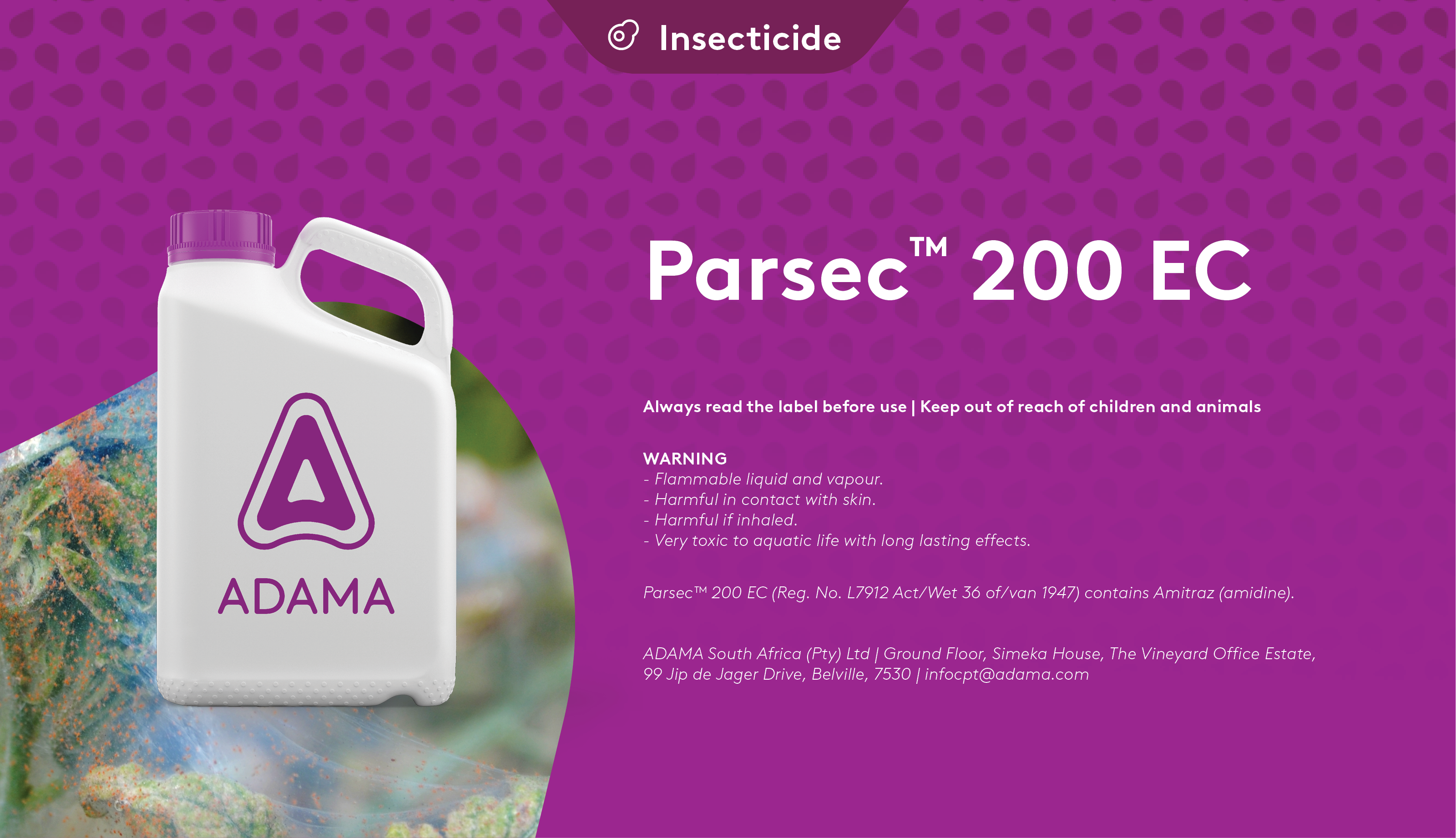
Parsec™ 200 EC
Parsec™ 200 EC (Reg. no. L7912 Act 36 of 1947) is an emulsifiable concentrate contact and residual acaricide for the control of eggs, larvae and adults of mites on crops as indicated. Its active ingredient is Amitraz (amidine).
Apply Parsec™ 200 EC only in transplanted tomatoes. Commence application as soon as the first sign of pests is noticed. Depending on plant size apply at 500–2000 L spray mixture/ha. Ensure thorough wetting of the upper and lower leaf surfaces. This application can be made only once per growing season. The withholding period (the minimum number of days between last application and harvest) is five days in tomatoes.
In the case of export crops, local maximum residue levels (MRLs) will not be exceeded if Parsec™ 200 EC is used according to the label instructions. However, ADAMA South Africa (Pty.) Ltd. cannot be held responsible if export MRLs are exceeded by following the label instructions. The local export marketing bodies must be consulted regarding application timing, withholding periods and specific tolerances of countries where produce will be exported to.
Hazard warnings: Parsec™ 200 EC is a flammable liquid and vapor. It is harmful if inhaled or if it comes into contact with the skin and can cause allergic skin reaction. It can cause serious eye damage and may cause damage to organs through prolonged or repeated exposure (liver and central nervous system). It is very toxic to aquatic life with long-lasting effects.
Always read the warnings and follow instructions on the label here.
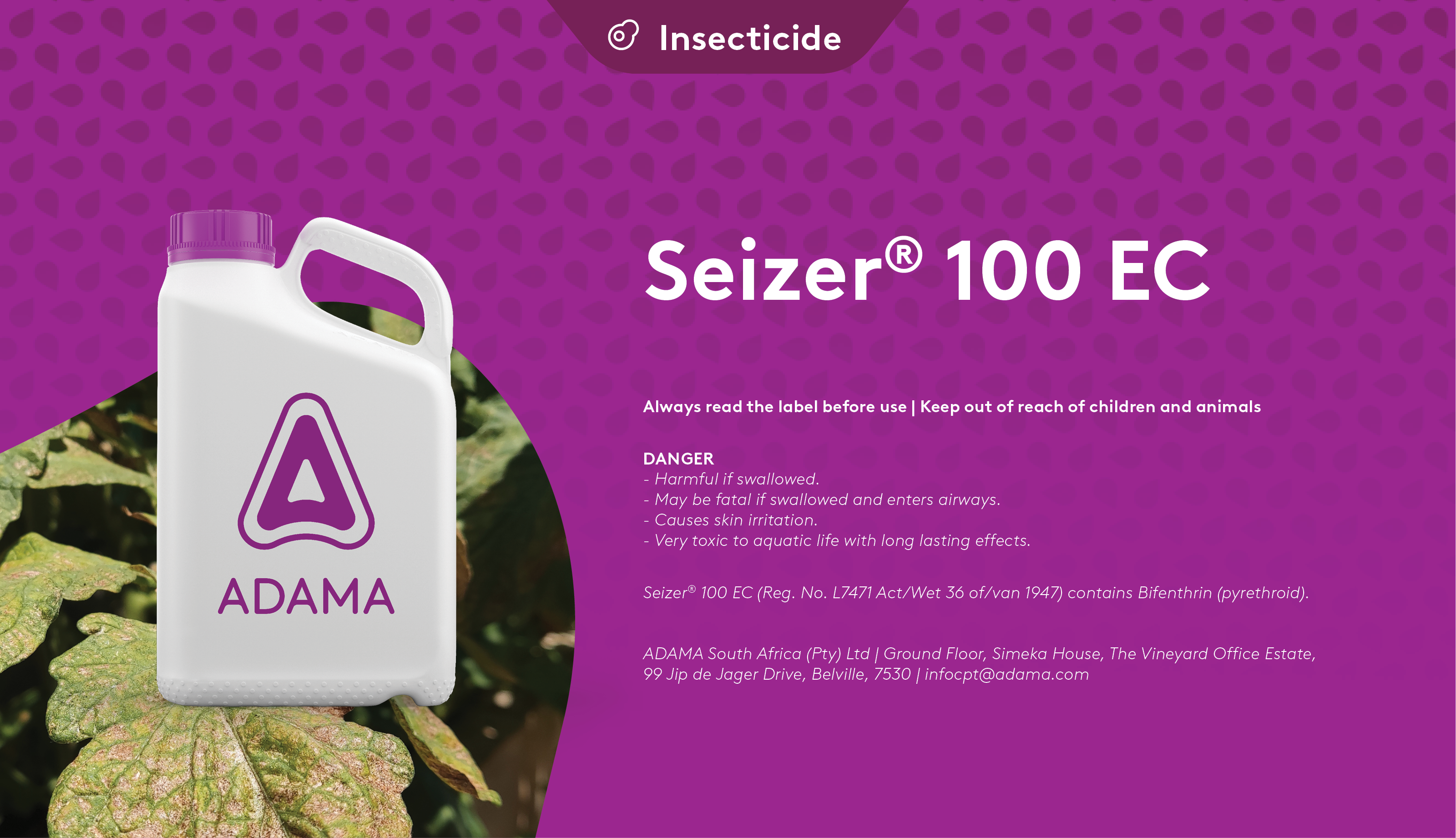
Seizer® 100 EC
Seizer® 100 EC (Reg. no. L7471 Act 36 of 1947) is an emulsifiable concentrate contact and stomach insecticide and acaricide for the control of pests in crops as indicated. Its active ingredient is Bifenthrin (pyrethroid).
For resistance management, Seizer® 100 EC is a group code 3A insecticide. Any insect population may contain individuals naturally resistant to SEIZER® 100 EC and other group code 3A insecticides. The resistant individuals can eventually dominate the insect population if these insecticides are used repeatedly. These resistant insects may not be controlled by Seizer® 100 EC or any other group code 3A insecticide.
For specific information on resistance management contact the registration holder of this product.
For tomatoes, apply Seizer® 100 EC as a full cover spray in at least 500 L water/ha. Ensure thorough wetting of the plants and especially the undersides of leaf surfaces. In trellised tomatoes, spray on both sides of the row. Under severe infestation levels repeat application within 7 days. (Refer to resistance warning above).
Danger: Seizer® 100 EC may be fatal if it is swallowed and enters airways. It can lead to drowsiness or dizziness, and can cause skin irritation and serious eye damage. It may cause damage to organs through prolonged or repeated exposure, is toxic to bees and wildlife, and very toxic to aquatic life with long-lasting effects.
Always read the warnings and use instructions on the label here.
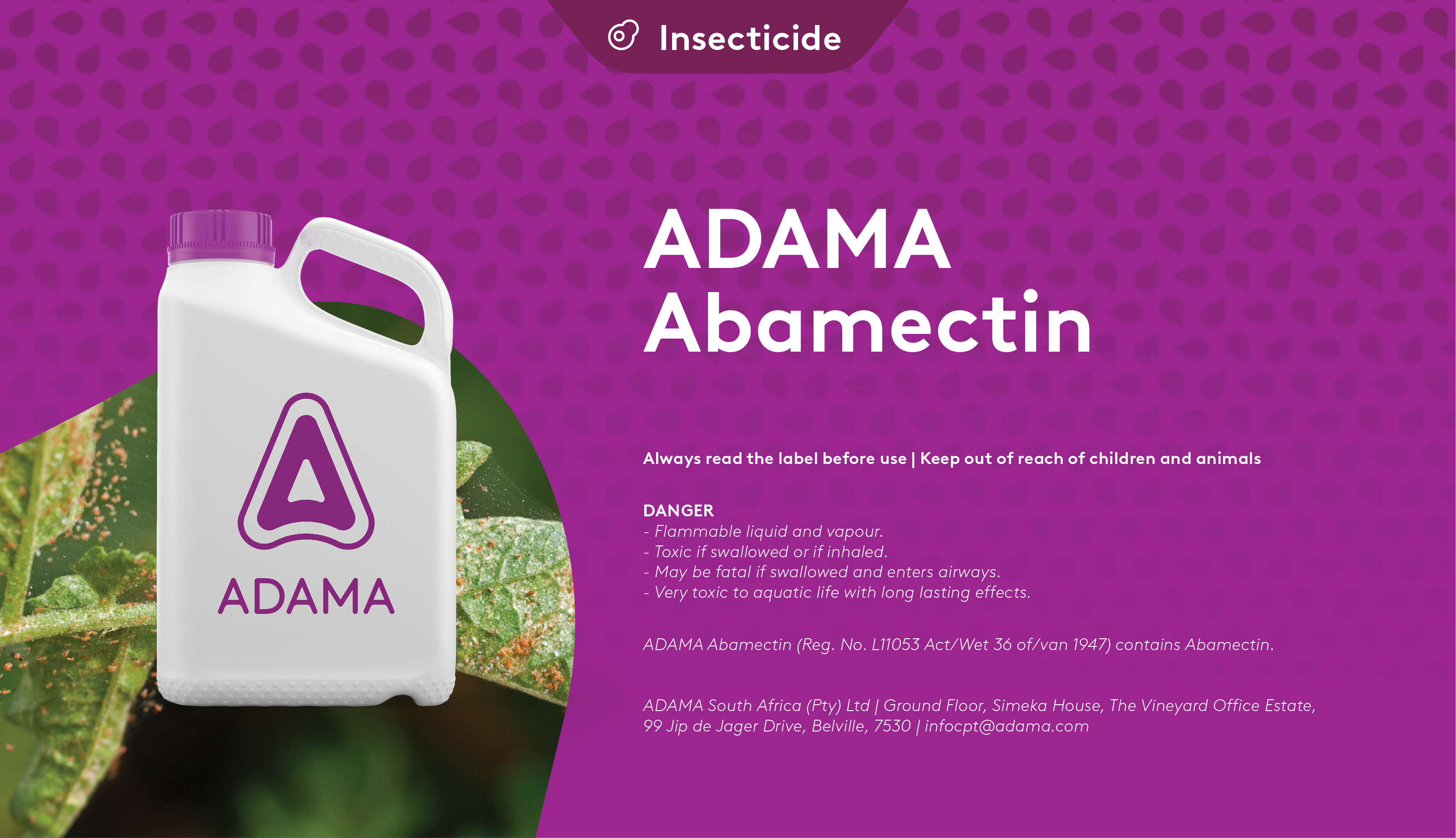
ADAMA Abamectin
ADAMA Abamectin (Reg. no. L11053 Act 36 of 1947) is an emulsifiable concentrate translaminar insecticide/acaricide with stomach and direct contact action for the control of American leafminer and spider mites on crops, flowers and ornamentals, as listed.
For tomatoes, apply ADAMA Abamectin at the first signs of infestation as a high volume, high pressure, full cover spray to point of runoff, using up to 2000 L spray mixture per hectare. Ensure good coverage of all leaf surfaces.
If less than 500 L spray mixture is applied, when spraying young plants, a minimum of 300 ml ADAMA Abamectin per hectare must be applied in sufficient water to provide a full cover spray. Never exceed 1200 ml ADAMA Abamectin per hectare. For red spider mite, repeat application as necessary.
For resistance management, ADAMA Abamectin is a group code 6 insecticide. Any insect/mite population may contain individuals naturally resistant to ADAMA Abamectin and other group code 6 insecticides. The resistant individuals can eventually dominate the insect/mite population if these insecticides are used repeatedly. These resistant insects/mites may not be controlled by ADAMA Abamectin or any other group code 6 insecticide.
Due to the inherent risk of resistance development to any product, it is strongly recommended that ADAMA Abamectin is used in a good resistance prevention programme. This programme should include the use of products with different modes of action and from different chemical groups. Applications should only be made based on scouting results for the pests.
Danger: ADAMA Abamectin is a flammable liquid and vapor. It is toxic and may be fatal if swallowed or inhaled. It causes skin irritation, serious eye irritation and may cause respiratory irritation. It is suspected of damaging fertility or the unborn child. It may cause damage to organs (central nervous system, liver, kidneys) through prolonged or repeated exposure (via inhalation). It is very toxic to aquatic life with long-lasting effects.
Always read the warnings and follow instructions on the label here.
Important to remember
With any chemical, and in terms of ADAMA’s regulations, always read the label before use. Take note of signal words and hazard statements on the labelling. ADAMA complies with the Regulations Relating to Agriculture Remedies (promulgated on 25 August 2023) under the Fertilisers, Farm Feeds, Agricultural Remedies and Stock Remedies Act, 1947 (Act 36 of 1947); and always provides the correct names of active ingredients in its products.
ADAMA South Africa (Pty) Ltd
Ground Floor, Simeka House
The Vineyard Office Estate
99 Jip de Jager Drive
Belville, 7530
infocpt@adama.com