

Managing diseases in Maize, Soybeans, Wheat and Barley
Mid-season disease control is critical in maintaining healthy crops and ensuring optimal yields. Maize, soybeans, wheat and barley are susceptible to various fungal diseases that can compromise production.
Phaeosphaeria leaf spot or maize white spot
One of the most concerning diseases that threatens maize is maize white spot (MWS), also known as Phaeosphaeria leaf spot. It is a destructive fungal infection that requires strategic management. First noted in India, it has recently spread widely in other parts of the world such as Brazil, USA, and Central, East and southern Africa, where South Africa, as the largest maize producer in the region, has experienced severe epidemics. The disease is predominant in areas of high rainfall and moderate temperatures.
Custodia® 320 SC is one of the fungicides registered for controlling this disease, making it a vital tool for maize farmers.
Life cycle
The disease progresses through the following stages:
- Spore production: Under favourable conditions (high humidity and moderate temperatures), the fungus produces asexual spores (conidia) and sexual spores (ascospores) in infected plant residues.
- Dispersal: The spores are dispersed by wind and rain splash to healthy plants, leading to widespread infection.
- Lesion formation: The infection starts with dark green, water-soaked spots that gradually become necrotic. The lesions expand and take on a straw-like appearance, with necrotic centres.
- Reproductive structures development: In later stages, pycnidia (asexual structures) and perithecia (sexual structures) form in necrotic lesions, releasing more spores to restart the infection cycle.
- Pathogen overwintering: The fungus survives in maize debris and infected residues, ensuring persistence for the next growing season.
Identification
- Stage 1: Small, dark green, water-soaked lesions appear on leaves.
- Stage 2: Lesions turn grayish as chlorophyll is depleted.
- Stage 3: The lesions become necrotic and straw-coloured.
- Stage 4: Fungal reproductive structures (pycnidia and perithecia) develop within the necrotic lesions.
Management strategies
Implementing an integrated disease management approach can significantly reduce the impact of MWS/Phaeosphaeria leaf spot. Crop rotation is essential to reducing pathogen survival in crop residues, while ploughing under infected debris minimises fungal overwintering.
Custodia® 320 SC, containing azoxystrobin and tebuconazole, provides systemic, translaminar and contact action against MWS/Phaeosphaeria leaf spot. Additionally, oxytetracycline treatments have been shown to suppress Pantoea ananatis, significantly reducing disease incidence. Planting resistant maize hybrids can also mitigate infection risk, offering a proactive defense against the disease.

Other key diseases in maize, soybeans, wheat and barley
1. Northern leaf blight (Exserohilum turcicum) - Maize
Life cycle: Overwinters in debris → spores spread by wind → infects leaves → lesions produce new spores.
Identification: Large, cigar-shaped, grayish-green lesions on leaves.
Control: Fungicide application (Custodia® 320 SC), crop rotation and residue management.
2. Common brown rust (Puccinia sorghi) - Maize
Life cycle: Windborne spores infect leaves → pustules develop → secondary spores spread.
Identification: Small, reddish-brown pustules on both leaf surfaces.
Control: Fungicide treatment (Custodia® 320 SC) and resistant hybrids.
3. Grey leaf spot (Cercospora zeae-maydis) - Maize
Life cycle: Fungal spores survive in crop debris → spread via wind and rain → infect leaves → lesions produce spores.
Identification: Rectangular greyish-brown lesions, often in parallel formation.
Control: Timely applications of fungicides like Custodia® 320 SC, residue management and proper field spacing.
4. Soybean rust (Phakopsora pachyrhizi) - Soybeans
Life cycle: Spores spread through wind → infection occurs on leaves → pustules develop, releasing new spores.
Identification: Small, raised, rust-colored pustules on lower leaf surfaces.
Control: Early detection, fungicide sprays such as Custodia® 320 SC, and resistant varieties.
5. Powdery mildew (Blumeria graminis) - Wheat
Life cycle: Airborne spores land on leaves → white powdery fungal growth develops → new spores spread the infection of powdery mildew.
Identification: White powdery patches on leaves and stems.
Control: Crop rotation, resistant cultivars and preventive fungicide sprays, for example Custodia® 320 SC.
6. Glume blotch (Septoria nodorum) - Wheat
Life cycle: Spores develop on infected plant debris → spread to new plants via rain splash.
Identification: Dark, irregular lesions on glumes and leaves.
Control: Crop sanitation and timely fungicide application (Custodia® 320 SC).
7. Net blotch (Pyrenophora teres) - Barley
Life cycle: Overwinters on crop residues → releases spores in wet conditions → infects leaves and spreads further.
Identification: Net-like dark brown lesions on leaves.
Control: Crop rotation, resistant varieties and application of a fungicide like Custodia® 320 SC.
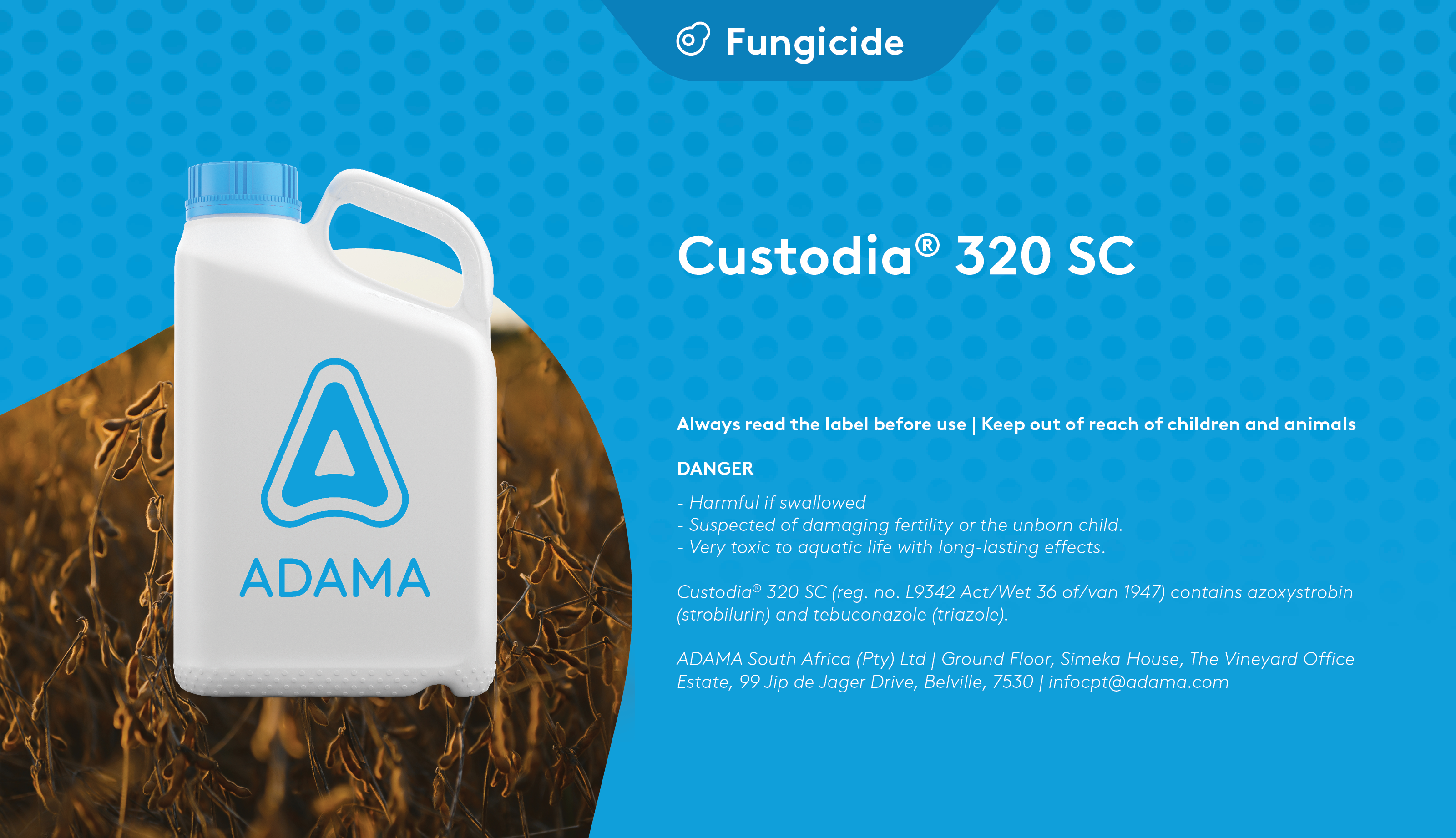
The role of Custodia® 320 SC in disease control
Custodia® 320 SC is a broad-spectrum fungicide that combines azoxystrobin (strobilurin) and tebuconazole (triazole) for a number of diseases in barley, black wattle, grain sorghum, maize, sweet corn, soybeans, wine grapes and wheat.
It is registered for control of the following diseases in the following crops:
Maize: Northern leaf blight (Exserohilum turcicum),common brown rust (Puccinia sorghi), Phaeosphaeria leaf spot (Phaeosphaeria maydis), sorghum downy mildew (Sclerospora sorghi), grey leaf spot (Cercospora zeae-maydis).
Soybeans:Soybean rust (Phakopsora pachyrhizi).
Wheat: Glume blotch (Septoria nodorum), powdery mildew (Blumeria graminis), speckled leaf blotch (Septoria tritici), eye spot (Pseudocercosporella herpotrichoides), brown rust (Puccinia triticina).
Barley: Net blotch (Pyrenophora teres), leaf spot/blotch (Rhynchosporium secalis), Ramularia leaf spot (Ramularia collocygni).
Warnings
Always follow the usage instructions and safety precautions on the label.
Precautionary statements
Avoid release to the environment.
Collect spillage
Custodia® 320 SC - Active ingredients: azoxystrobin/tebuconazole
Registration number referencing Act 36 of 1947: L9342
Address of Registration holder: 99 Jip de Jager drive, The Vineyards Office Estate, Simeka House, De Bron 7530, South Africa