

Inside the ADAMA Solutions Site - October edition
Water security is becoming one of the most important long-term considerations for turf managers. At the ADAMA Solutions Site, St Leonards Golf Club is taking a practical approach—combining desalination, renewable energy and major on-course water storage projects to build greater resilience into the property.
Located on Victoria’s Bellarine Peninsula, the ADAMA Solutions Site operates within the working environment of St Leonards Golf Club. With no unlimited or guaranteed irrigation supply to rely on, securing and storing water is critical to protecting the club’s turf surfaces through summer and increasingly variable seasonal conditions.
Rather than treating water infrastructure purely as an engineering requirement, the club is integrating it into the golf course itself—creating additional irrigation storage while simultaneously improving course strategy, aesthetics and maintenance efficiency.
Turning bore water into an irrigation resource
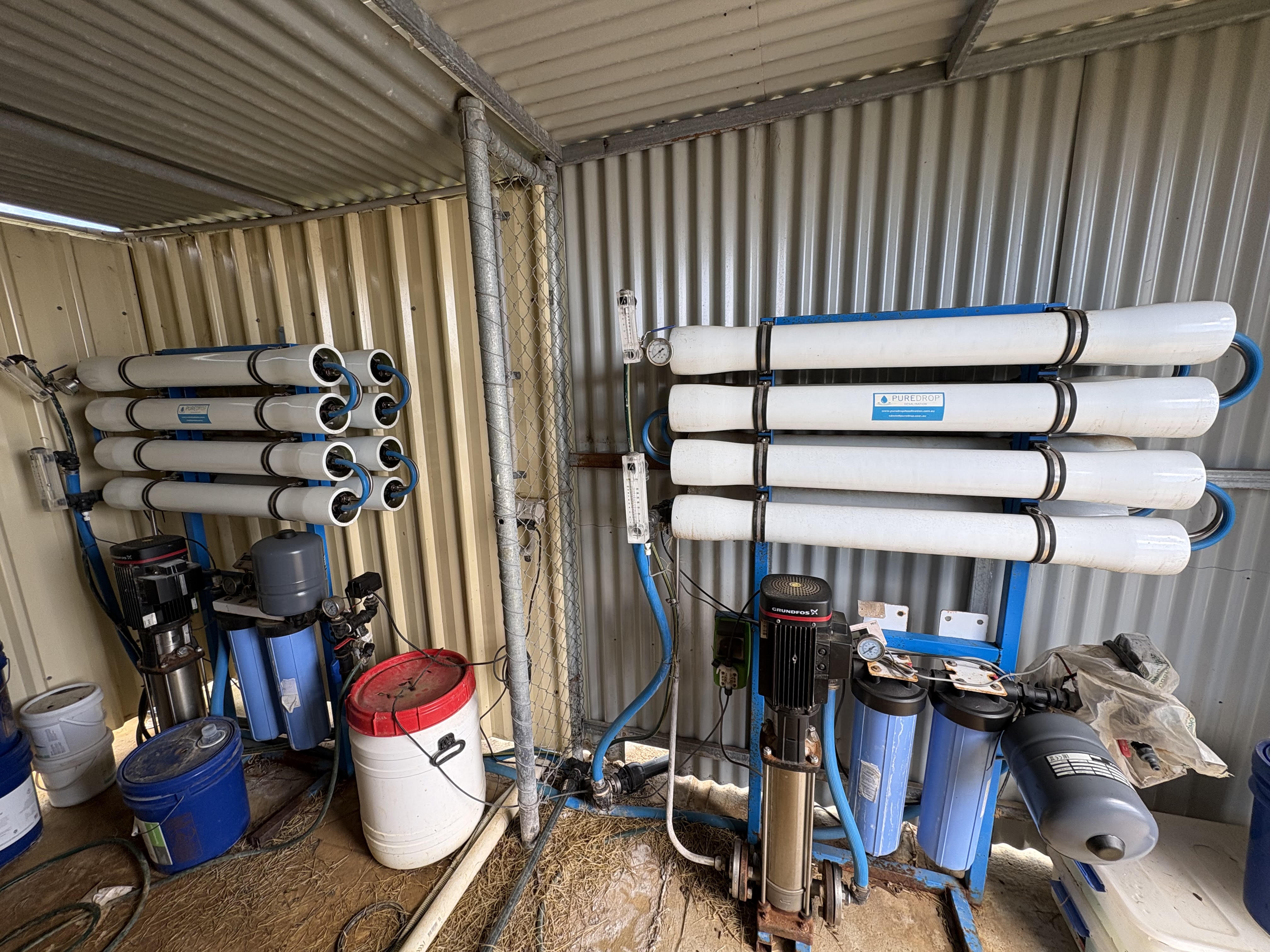
At the centre of the club’s water strategy is a small desalination plant capable of producing approximately 40,000 litres of high-quality water per day.
The plant takes bore water containing approximately 6,800 ppm of dissolved salts and treats it through reverse osmosis, providing a valuable supplementary source of irrigation water.
The treated water is transferred into the club’s irrigation storage system, where it combines with harvested rainfall before being distributed around the golf course.
During summer, when irrigation demand is greatest, the desalination plant operates around the clock. During winter, when demand is considerably lower, operation is primarily restricted to daylight hours.
That operating strategy has been made possible by another major investment.
$100,000 investment in solar and battery storage
St Leonards Golf Club has recently invested approximately $100,000 in a new solar and battery system, providing renewable energy to support the desalination plant as well as the club’s broader electricity requirements.
For a completely volunteer-run golf club, it represents a significant investment—but one aimed at reducing the long-term cost of producing irrigation water and improving the resilience of the club’s water supply.
The combination of solar generation, battery storage and desalination effectively allows the club to turn an otherwise unsuitable saline bore-water resource into irrigation water using energy generated on site.
Making use of the desalination brine
Desalination inevitably produces a concentrated waste stream, so managing that water forms another part of the overall system.
Brine from the desalination plant is pumped into an approximately 4,000 m² purpose-built wetland and evaporation pond, generally less than one metre deep.
Rather than hiding this infrastructure away, the wetland has been incorporated into the golf course as a visual and strategic featureIts large, shallow surface area encourages evaporation during the warmer months. As water evaporates, additional storage capacity is created for subsequent brine produced by the desalination process.
It is another example of infrastructure performing more than one role within the Solutions Site.
Adding approximately 30 megalitres of storage
The next stage is substantially increasing the amount of water the club can hold.
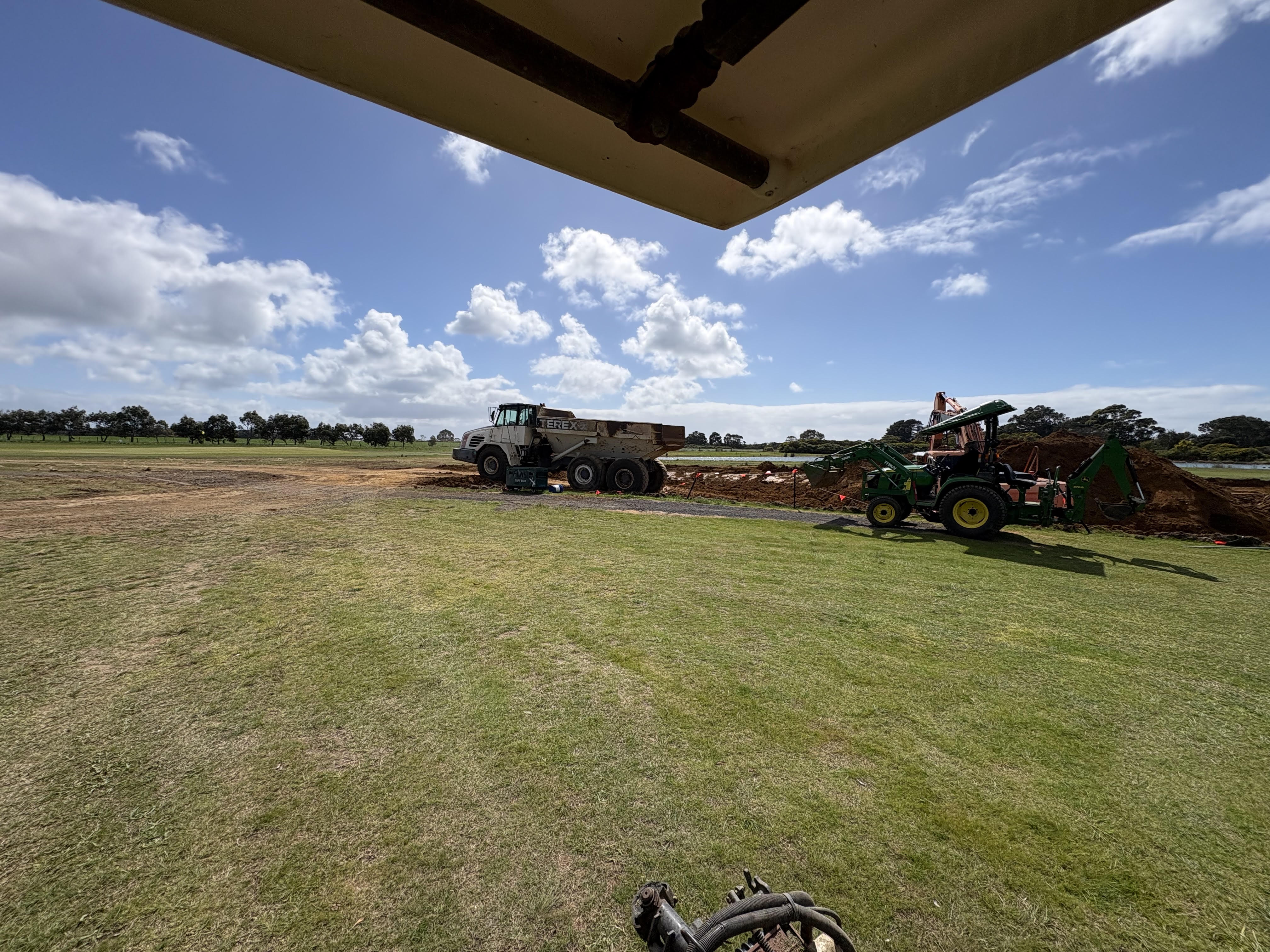
St Leonards has purchased a second-hand 25-tonne excavator and 25-tonne articulated dump truck, allowing major earthworks to be undertaken in-house.
Importantly, the machinery is being operated by skilled club volunteers with previous professional experience operating heavy equipment.
Current works involve excavating a series of new lakes and expanding water storage areas throughout the property. Once completed, the projects are expected to increase total available water storage by approximately 30 megalitres—or 30 million litres.
For a relatively small golf facility, that additional storage provides an important buffer between periods of rainfall and peak summer irrigation demand.
Water infrastructure that improves the golf course
The new lakes have not simply been positioned wherever excavation is easiest.
They are being incorporated as strategic golf course features, with the works designed by ADAMA Commercial Manager – Non Crop Ben Davis, who is also a qualified golf course architect and designed the St Leonards course redevelopment.
Their positioning allows the water bodies to influence playing strategy, define holes and improve the visual character of what was originally an extremely flat paddock.
There is also a significant maintenance benefit.
Replacing selected areas of maintained rough with permanent water features reduces the area requiring regular mowing and ongoing inputs—an important consideration on a golf course maintained entirely by volunteers.
Nothing goes to waste
Excavating 30 megalitres of additional storage generates a considerable amount of material, but that fill is also being put to work.
Rather than being removed from the property, excavated material is being transported around the golf course and used to construct strategic mounding and new golf features.
For a site that began as a largely dead-flat paddock, the earthworks provide an opportunity to introduce contour, definition and visual separation between holes.
The result is an interconnected project: excavation creates additional water security; the new lakes become strategic golf hazards; maintained rough area is reduced; and the excavated material is reused to improve the character and strategy of the course.
A practical approach to long-term resilience
There is no single solution to water security.
At St Leonards, the approach combines rainfall harvesting, desalination, solar generation, battery storage, evaporation management and increased on-course storage.
Individually, each plays a role. Together, they provide the club with greater control over one of the most important resources required to maintain quality turf.
And because the work is occurring within the ADAMA Solutions Site, it provides another real-world example of the broader challenges facing turf managers—not simply how turf is treated, but how facilities can become more resilient, efficient and sustainable over the long term.
Over the coming months, ADAMA Turf Management Insights will continue following the construction works as the new lakes take shape, the excavated material is incorporated into the golf course and the additional water storage comes online.
Real turf. Real conditions. Real-world solutions
Media Contact:
Cam Stuart| General Manager - Non-Crop | E: Cameron.stuart@adama.com