

Post renovation turf protection at the ADAMA Solutions Site
Renovation sets up the turf for summer, but the weeks that follow determine how successfully that work translates into healthy, consistent playing surfaces. At the ADAMA Solutions Site at St Leonards Golf Club, November’s planned program combines targeted disease and insect protection with soil test driven nutrition, followed by growth regulation once recovery is complete. The operational aim is one spray pass per week, tank mixing as many compatible inputs as possible to minimise machinery traffic and disruption to play.
With temperatures rising, rainfall anticipated and fertiliser supporting renewed growth, the priority is to protect the recovering greens from Pythium and other diseases while rebuilding a dense, uniform canopy. Across tees, fairways and surrounds, the focus then shifts to managing growth, broadleaf weeds and playing quality.
Preparing the greens for recovery
The greens were double verti-cut, hollow cored using 5/8-inch tines, fertilised, treated with amendments and topdressed. Fertiliser and amendment selections were based on soil testing, with follow-up nutrition also guided by those results and the turf’s response.
Before renovation, Quali-Pro Enclave and Quali-Pro Triumph Advance were applied preventatively. Enclave supplied broad spectrum contact and systemic protection against its registered turf diseases, while Triumph Advance specifically targeted Pythium. That distinction matters: broad spectrum disease protection does not automatically provide adequate control of oomycete diseases such as Pythium.
Why Pythium is the immediate priority
Warm, humid conditions and extended leaf wetness can favour Pythium leaf blight, while prolonged rootzone wetness increases concern about Pythium root rot. A fertiliser driven flush of susceptible growth can add to foliar disease pressure. The response is preventative protection coupled with measured nutrition and irrigation that supports recovery without keeping the surface or rootzone unnecessarily wet.
Leaf blight and root rot require different application strategies. A foliar treatment must protect the leaf; a rootzone treatment must reach the crown and roots. Water volume, droplet selection and irrigation timing are therefore part of the disease control decision, rather than simply spray logistics.
Other priorities include dollar spot during humid, dewy periods, brown patch as warm, wet conditions develop, and anthracnose where close mowing and plant stress increase susceptibility. Nutrition must remain balanced: avoiding excessive nitrogen should not become nitrogen starvation, particularly where dollar spot and anthracnose are concerns.
Week one establishing broad spectrum protection
Quali-Pro Evolution Advance is the broad spectrum foundation of the first November foliar application. It contains 370 g/L tebuconazole and 222 g/L azoxystrobin, combining Group 3 and Group 11 fungicide activity. Tebuconazole inhibits sterol biosynthesis, while azoxystrobin inhibits mitochondrial respiration. Together they target different stages of disease development, with preventative application providing the best opportunity to protect new growth.
Its registered disease spectrum includes anthracnose, brown patch, dollar spot and Helminthosporium diseases, as well as Pythium under the appropriate directions for use. The planned 500 L/ha foliar carrier volume sits within the technical guide’s 350–500 L/ha range for foliar applications. Root disease targeting requires a different placement strategy.
Magellan adds dedicated preventative Pythium protection. Containing 800 g/kg fosetyl aluminium, it moves both upwards and downwards within the plant and also supports the plant’s natural defence response. It is scheduled in weeks one and three, consistent with the guide’s 14–21 day preventative interval while disease conditions remain favourable.
The week one and week three foliar passes use 500 L/ha, meeting the lower end of Magellan’s 500–1,000 L/ha foliar range for Pythium leaf blight. This allows Magellan to be included in the weekly foliar tank mix rather than requiring an additional spray pass. Rootzone Pythium protection is addressed through the soil directed week two application of Triumph Advance.
Compass protecting leaves and managing algae
Quali-Pro Compass contains 500 g/L fluazinam, a Group 29 contact fungicide that disrupts fungal energy production. Its activity against dollar spot, anthracnose, Grey Leaf Spot and Helminthosporium diseases complements systemic chemistry by protecting the treated surface. Its different mode of action also broadens the chemistry used within the program.
In the week one foliar tank mix, Compass supplies contact protection against its registered leaf diseases, complementing Evolution Advance and Magellan. Its separate registration for algae and Pythium is also useful within turf programs, but those targets require placement at the soil surface or crown and the specified wash-in. The 500 L/ha foliar pass is therefore described here as leaf disease protection, rather than as an algae directed treatment.
Venom targeting Argentine stem weevil adults
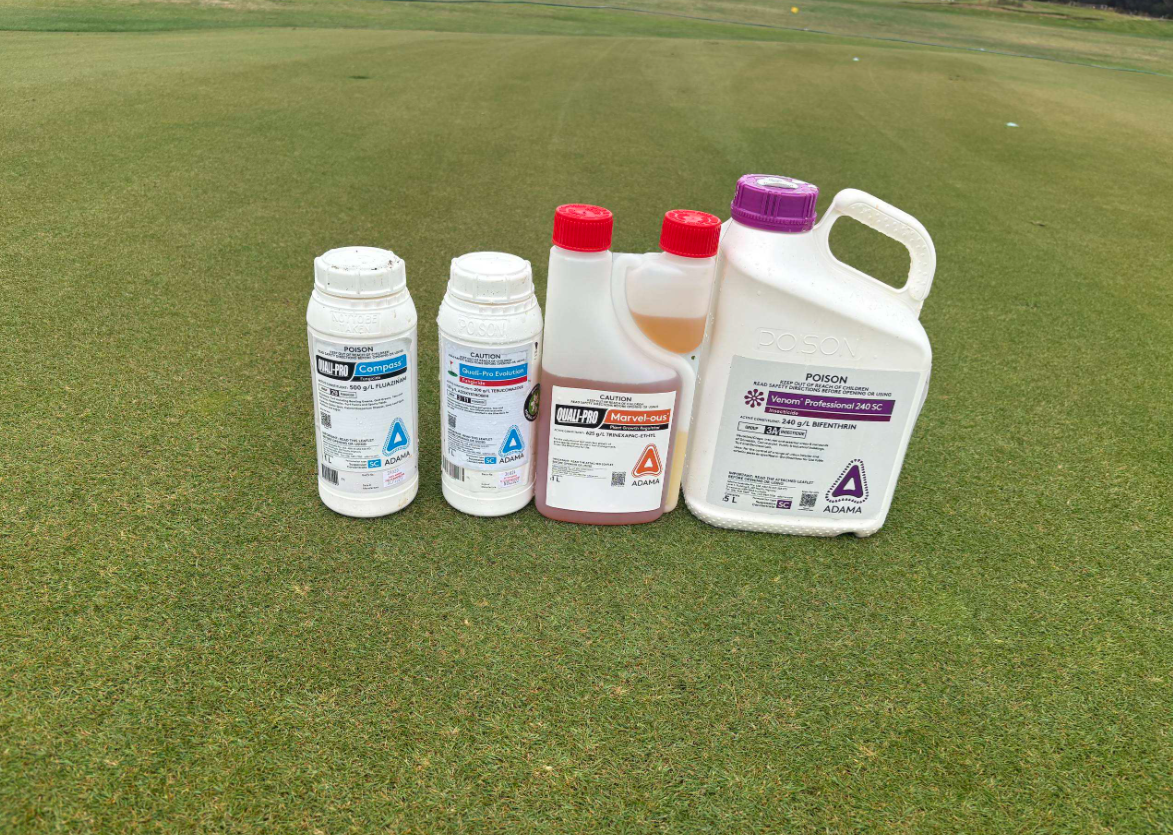
Venom Professional 240SC contains 240 g/L bifenthrin, a Group 3A insecticide. Its role in week one is control of Argentine stem weevil adults where monitoring supports treatment. The adult target is important: this application should not be described as control of larvae already feeding within stems. Pest stage, activity and label directed application and irrigation govern its use. Its inclusion in the weekly mix depends on reconciling its label directed irrigation with the other partners’ foliar retention requirements.
Week two protecting the rootzone
Quali-Pro Triumph Advance is scheduled in week two to maintain targeted Pythium protection through a different mode of action. Its 800 g/L metalaxyl-M is a Group 4 fungicide with rapid uptake and upward systemic movement. It is registered for Pythium leaf blight, root rot and seedling damping off, and its specific role here is protection against rootzone disease during a period when moisture and temperature may favour infection.
Week two consolidates Triumph Advance, the wetting agent and Contrado into one planned soil directed spray pass at more than 800 L/ha, subject to label and compatibility requirements. Nozzle selection and prompt irrigation move the treatments towards the target zone. The Triumph Advance guide specifies at least 6 mm irrigation immediately where possible and no later than one hour after application; the Contrado guide also specifies 6 mm for soil dwelling pests. This shared placement requirement makes week two the logical opportunity to combine rootzone protection, insect management and wetting agent application.
The wetting agent in this phase supports more uniform water movement and moisture management; it does not replace drainage or justify prolonged saturation. Its selection and irrigation requirements must suit the site’s soil conditions and the intended treatment placement.
Contrado provides the insect protection component of week two. It contains 200 g/L chlorantraniliprole, a Group 28 ryanodine receptor modulator that disrupts insect muscle function and stops feeding. Its residual activity makes it useful for preventative management of registered pests including scarab larvae, Argentine stem weevil and billbug.
Timing should follow local pest development and monitoring rather than the calendar alone. The Contrado guide stresses early preventative timing for stem weevil and billbug and application before or around peak egg hatch for scarabs. For soil dwelling pests it specifies at least 400 L/ha and 6 mm post-application irrigation. The November placement should therefore be checked against local pest stage and any earlier insecticide applications.
Week three renewing protection with Enclave
Quali-Pro Enclave returns in week three alongside Magellan and foliar nutrition. Enclave combines 365 g/L chlorothalonil, 119 g/L iprodione, 119 g/L thiophanate-methyl and 36 g/L tebuconazole, providing contact, locally systemic and systemic activity through Groups M5, 2, 1 and 3.
This combination provides broad protection against registered diseases including dollar spot, brown patch, anthracnose and Helminthosporium diseases. Chlorothalonil protects the treated surface, while the penetrating components extend activity within plant tissues. Magellan supplies the specific Pythium component of this phase.
Enclave’s planned 500 L/ha foliar application is within its guide’s 200–750 L/ha range and also accommodates Magellan’s foliar water requirement in the same weekly tank. Foliar fertiliser and Marvel-ous, once recovery permits, are incorporated wherever compatible. Both Evolution Advance and Enclave contain tebuconazole, so resistance planning must account for this shared Group 3 exposure, the pre-renovation treatments and subsequent summer applications.
Marvel ous managing density and green speed after recovery
Quali-Pro Marvel-ous has an important role once the greens have recovered and are actively growing. Its 625 g/L trinexapac-ethyl inhibits late stage gibberellic acid biosynthesis, reducing vertical shoot elongation. The product guide also identifies benefits for lateral stem and root mass development, supporting the objective of a denser, more uniform sward.
Reducing vertical growth and clipping production can help limit the accumulation of leaf growth between cuts and improve consistency of ball roll through the day. The aim is more predictable green speed and surface quality; a PGR does not replace appropriate mowing, rolling, moisture management or topdressing.
Timing is critical. The Marvel-ous guide advises avoiding use while turf recovery is required, including following renovation. Its week one and week three positions are therefore conditional on recovery, rather than automatic calendar applications. If coring holes and verti-cut lines are still healing or the turf remains stressed, growth regulation is deferred.
Once suitable for treatment, rates and repeat timing should follow the label, turf species, growth response and growing degree days. The guide cautions that DMI fungicides may add growth regulatory effects, so the tebuconazole in Evolution Advance and Enclave must be considered when assessing the overall response.
Week four growth and broadleaf management across the course
For tees, fairways and surrounds, week four is one planned foliar spray pass at 500 L/ha, combining soil test driven nutrition, Quali-Pro Crest for broadleaf weeds and Marvel-ous for growth regulation wherever label requirements and compatibility allow. Each component is selected for the turf species and condition of the area, with PGR use deferred wherever renovation recovery is incomplete.
On recovered fairways, Marvel-ous helps manage the growth response to warmer weather and fertiliser, reducing clipping production and mowing demand while supporting a more uniform surface. The same principle applies to suitable tees and surrounds, with species specific rates rather than a single blanket rate across different turf types.
Quali-Pro Crest contains 100 g/L fluroxypyr and 2.5 g/L florasulam. Fluroxypyr is a Group 4 synthetic auxin herbicide; florasulam is a Group 2 ALS inhibitor. The combination controls registered broadleaf weeds including white clover, bindii, pigweed and sowthistle, reducing competition as turf cover consolidates.
Crest is best applied to actively growing weeds with adequate soil moisture and thorough foliar coverage. Applications are restricted to suitable established, unstressed turf, avoiding drift onto greens. Its guide does not recommend use on creeping bentgrass golf or bowling greens and advises against application when rain is likely within three hours. A planned treatment date should move if recovery, turf stress or forecast rainfall makes conditions unsuitable.
Making the program work in the field
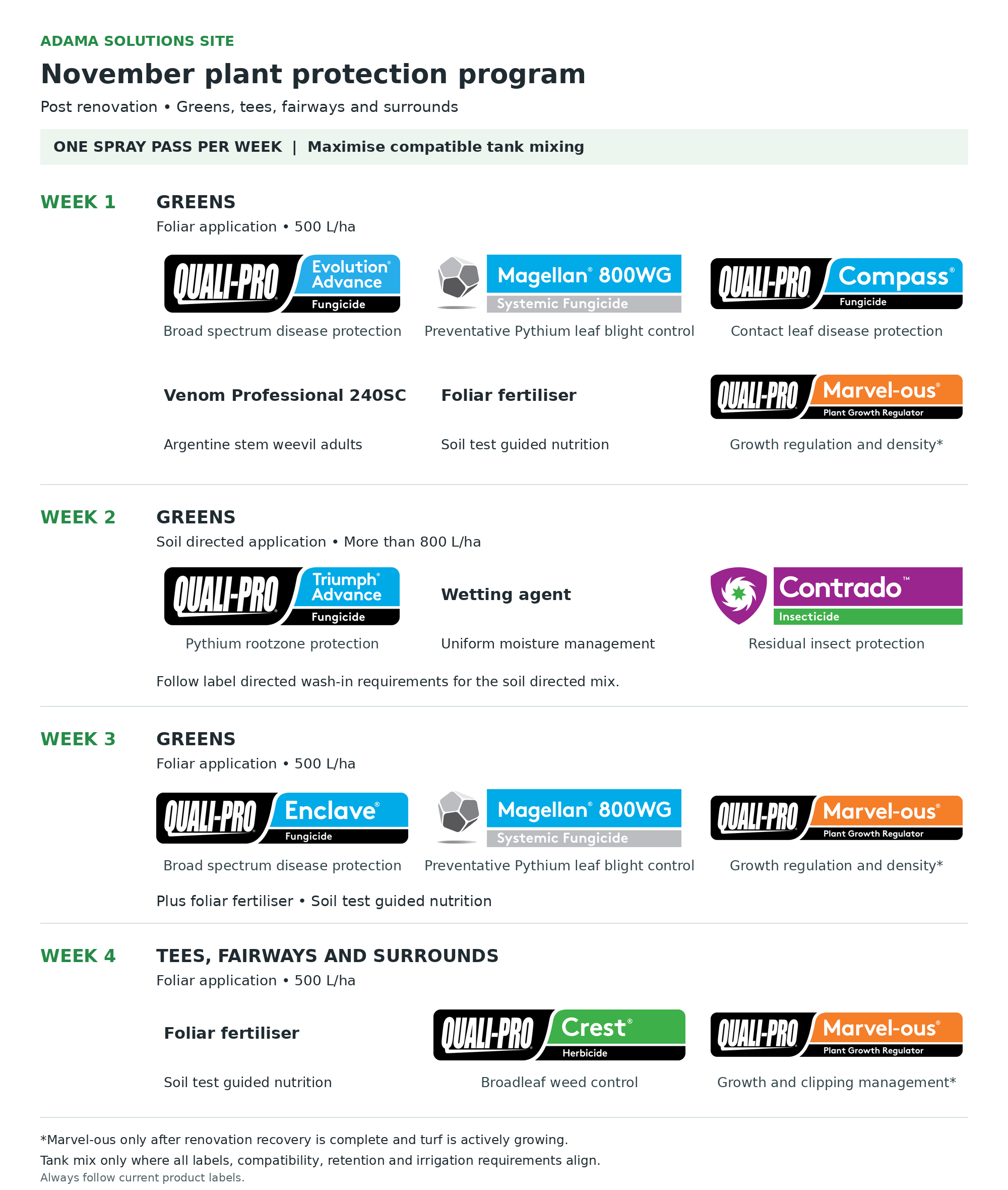
The program is built around one spray pass per week: foliar tank mixes at 500 L/ha in weeks one and three on greens, a soil directed mix at more than 800 L/ha in week two, and a 500 L/ha foliar mix across tees, fairways and surrounds in week four. Combining compatible products reduces repeat machinery passes and disruption to play. Final mixes must meet every partner’s label, retention, irrigation and compatibility requirements. Add Magellan last as directed in its guide and exclude copper containing products; a jar test confirms physical compatibility only.
At the Solutions Site, the objective is to protect the investment in renovation, then use ADAMA growth regulation and weed management tools to maintain the quality of the recovered surfaces as summer approaches.
Technical references for editorial review
Article copy ends on the preceding page. This reference page is for technical review and is not intended for inclusion in the EDM.
Primary sources: the eight supplied ADAMA technical notes for Magellan, Evolution Advance, Compass, Marvel-ous, Triumph Advance, Contrado, Enclave and Crest. Site operations and November scheduling are based on the supplied program. Last month’s Solutions Site article provided the series context.
Supplementary source: ADAMA Venom Professional 240SC label, APVMA approval 84018/117677, accessed 27 October 2026. The label confirms Group 3A bifenthrin and Argentine stem weevil adult control.
https://www.adama.com/australia/en/crop-protection/professional-consumer/venom-professional-240
Editorial adjustments: foliar carrier volumes are 500 L/ha to accommodate Magellan in the weekly foliar mix. The operating plan is one spray pass per week with maximum compatible tank mixing. Compass in week one is positioned for leaf diseases rather than a separate algae treatment. Week two combines soil directed inputs where compatible. Full multi-product mix compatibility and conflicting retention or irrigation requirements still require verification before application. Marvel-ous remains conditional on recovery; shared Group 3 exposure is identified.
Media Contact:
Cam Stuart | General Manager - Non-Crop | E: Cameron.stuart@adama.com