
Industry welcomes systems approach review for weed control in multiple crops
MIX, rotate and use multiple modes of action as part of a systems approach to achieve the best results with crop protection treatments.
These are common themes in the crop protection industry, but have seldom been showcased by commercial organisations in theory and in-field, and, compared with traditional summer industry research updates, also in real-time – until now.
In Western Australia, crop protection supplier ADAMA Australia recently held a week-long program of seminars and trial visits with a large contingent of rural agribusinesses, farm consultants, agronomists and researchers.
The company is also coordinating similar programs in South Australia and eastern States.
The seminars were held at York in WA’s Avon Valley region, and five trial sites featuring cereal, canola and pulse crops were visited from the local area though to West Talbot.
ADAMA Australia Market Development Manager Bevan Addison said a primary focus of the seminars and trials was to determine the best systems approach to weed control and resistance management challenges using all tools available to growers.
“We are not just looking at our own products. We are combining popular industry products to highlight the best systems approach to different challenges. We don’t believe any other organisations are looking at it from this perspective,” Bevan said.
“We may have an effective post-emergent herbicide in canola, like Tenet®, and we can show that by using a good pre-emergent herbicide from another company and stacking multiple modes of action together with Tenet for the post-emergent application, it can achieve a good outcome.
“It’s about looking at how to get the most out of structuring multiple herbicides together for problems like resistance management, and how to effectively utilise various products available, including in canola and pulse crop phases.”
He said the theory included in-depth explanations on how the stacking of multiple modes of action worked, including the biochemistry of different reactions and interactions of multiple herbicide groups and its importance for achieving maximum control.
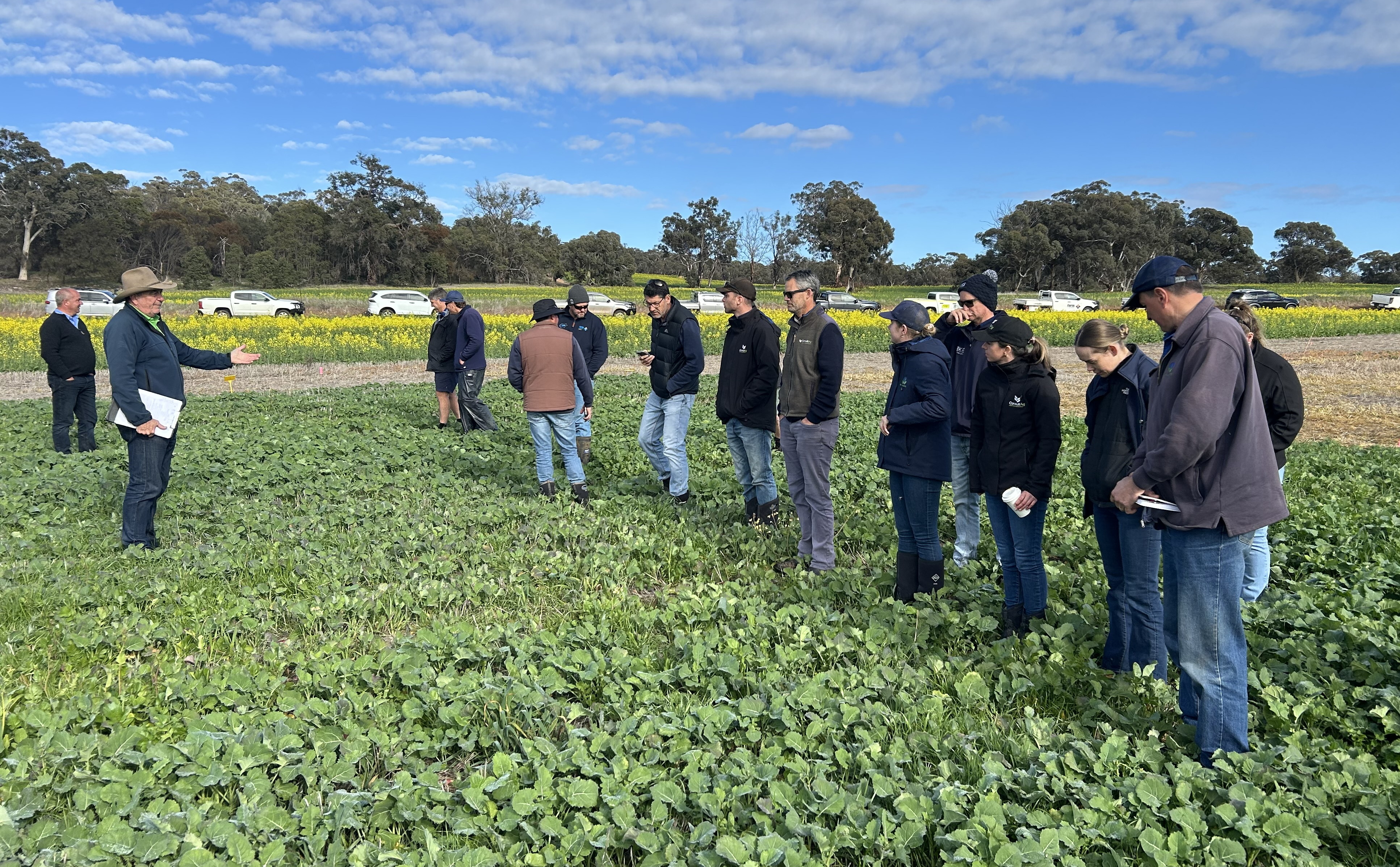
ADAMA Australia Market Development Manager Bevan Addison pictured discussing a systems approach to weed control in canola with farm consultants, agronomists, rural resellers and researchers at a trial site near York in WA.
Another major theme was determining how to use paraquat herbicide in farming systems under the new lower application rates now imposed on the industry.
“The systems approach was used to determine the best knockdown herbicides to apply following the restrictions on paraquat. This included the use of Sierra®, containing saflufenical, as a knockdown herbicide spike, plus its use with glyphosate and paraquat in knockdown programs,” Bevan said.
He said the effectiveness of combining Marathon® and Quadrant® herbicides in cereals, bringing together four modes of action and five active ingredients, was highlighted for maximum broadleaf weed control.
Marathon is ADAMA Australia’s patented, high-load pyrasulfotole herbicide that comes with a safener, allowing it to be easily tank-mixed with standard products like Quadrant and also ensuring crop safety.
“With Marathon and Quadrant, you get the multiple modes of action for broad spectrum coverage, plus a combination of very robust knockdown and residual control, so there are plenty of wins. It’s really robust even against populations with levels of resistance – and you get residual control,” Bevan said.
He said in pulse crops, the seminars discussed various ways of controlling grasses by using Ultro® herbicide pre-emergent or as a split application pre-emergent and post-sowing pre-emergent (PSPE), followed by post-emergent grass herbicide applications. Ultro could also be mixed with herbicides like Reflex® to target broadleaf weeds in addition to grasses.
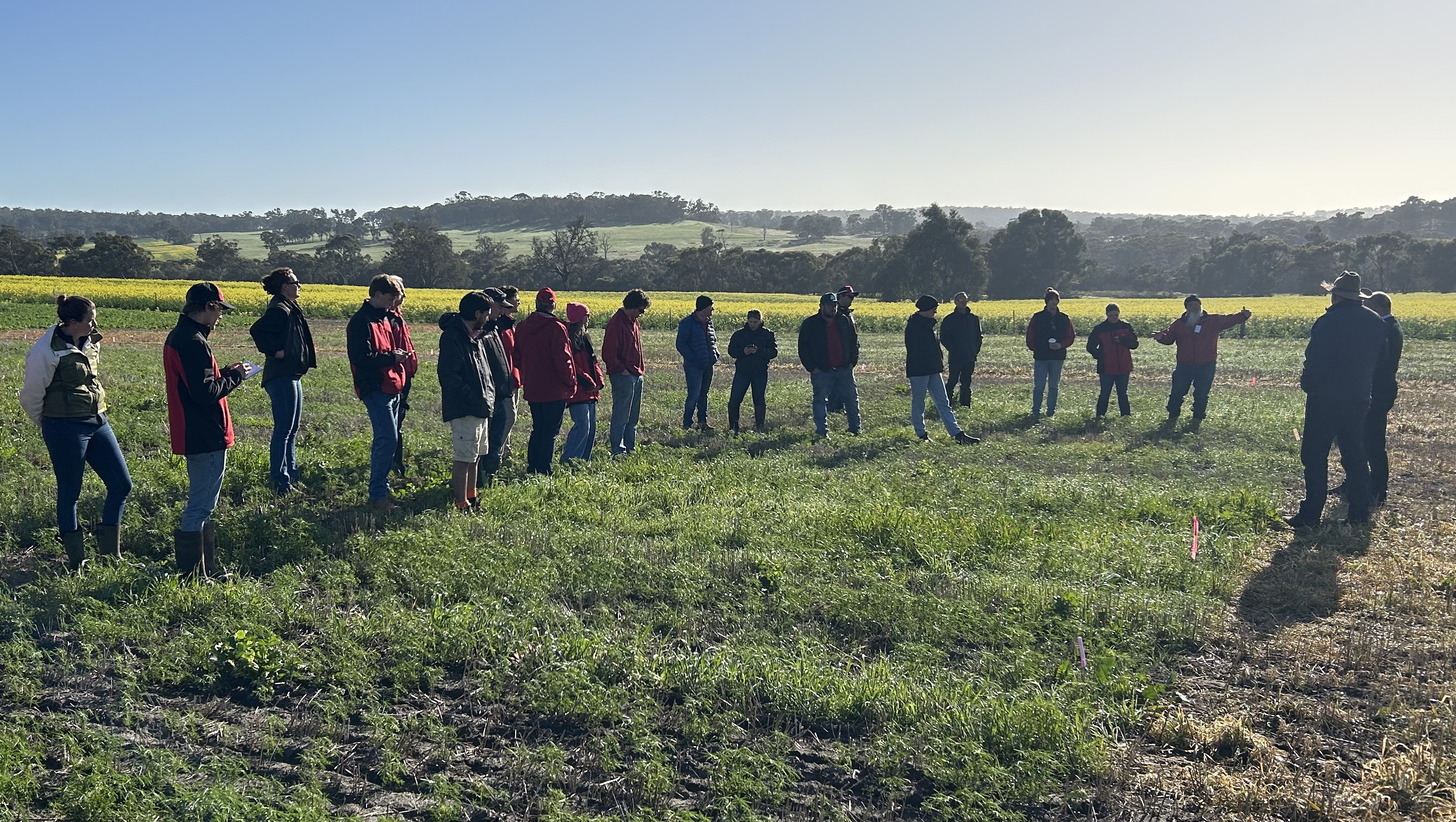
The ADAMA Australia team and representatives from Elders investigate weed control in lupins from a range of treatments at a trial site near York in WA.
In canola, the focus was on the importance of applying Tenet® herbicide for knockdown and residual control of ryegrass, as well as its effective use with clethodim, glyphosate and Liberty ULTRA® herbicides to improve grass weed control.
“There have been concerns around using some Liberty ULTRA herbicide programs, but if you use a robust pre-emergent, such as propyzamide or Overwatch®, followed by treatment combinations of Liberty ULTRA, clethodim and/or Tenet, also for residual control, or mix and match herbicides with glyphosate in Roundup Ready crops, you will get a better result,” Bevan said.
“Mixing all systems can give you a weed-free outcome. The same principle applies in all herbicide systems, including TT and IT canola crops.”
He said the theory in the seminars was demonstrated visibly during the trial site visits.
“There was a whole range of standard comparisons in the trials. The cereals focused on the stacking of multiple modes of action to control radish using a range of different treatments, whereas the other trials included a matrix of different pre-emergent and post-emergent applications, so a range of control systems could be viewed in the one trial.”
“In the lupins, Ultro was the clear standout performer for ryegrass control. In the canola, Tenet demonstrated it was an integral part of a systems approach incorporating a solid pre-emergent herbicide and use with other post-emergent herbicides to achieve good knockdown and residual control of weeds.'
Bevan said there had been strong, positive feedback from agricultural consultants who had since taken growers around some of the trial sites.
“One consultant said their grower clients were saying it was one of the most thought-provoking sessions they’d had for some time.”
For further information on the range of weed control systems and trials, agronomists and growers can contact their local ADAMA Australia representative.
Media Contact:
Paige Conroy | Marketing Manager | E: paige.conroy@adama.com