
Diamond®
An insect growth regulator (IGR) that provides broad-spectrum activity on susceptible immature insect stages of yield-damaging plant bugs, stink bug nymphs,...









What is Diamond?
Diamond is powered by AI novaluron and is insect growth regulator for row crop pest management programs in cotton, peanuts, sorghum, soybeans, sugarcane, and sunflower. It is designed for growers, crop consultants, retailers, and applicators who need broad-spectrum activity on susceptible immature insect stages of yield-damaging plant bugs, stink bug nymphs, caterpillars, and other foliage-feeding pests.
Diamond disrupts pest development before populations escalate by reducing egg hatch, suppressing immature stages, and supporting resistance-management and IPM programs. Its strongest fit is early when immatures insects are prevalent, program-based use where residual activity and lifecycle management can protect crop potential and reduce pressure on rescue treatments.
| Category | Notes |
| Product name | Diamond |
| Category | Insecticide; insect growth regulator (IGR) |
| Active ingredient | Novaluron |
| Formulation | Emulsifiable concentrate |
| Mode of action | IRAC Group 15; chitin synthesis inhibition; transovarian disruption; ingestion and contact activity |
| Target crops | Cotton; peanuts; sorghum; soybeans; sugarcane; sunflower |
| Target pests | Plant bugs/Lygus; stink bug nymphs; cotton fleahopper; armyworms; loopers; green cloverworm; Mexican bean beetle; velvetbean caterpillar; grasshopper nymphs; cutworms; sorghum midge; lesser cornstalk borer; corn earworm |
| Application method | Ground, aerial, or chemigation where allowed by label; consult label |
| Re-entry interval | 12 hours |
Diamond contains novaluron, a third-generation chitin synthesis inhibitor. It works by disrupting insect development, including reduced egg lay and hatch, activity on eggs and immatures, and transovarian effects that help slow population buildup.
The product is positioned early for its broad-spectrum activity on susceptible immature insect stages insect control in row crops where plant bugs, stink bug nymphs, Lepidoptera species, and other foliage feeders threaten yield. In cotton, the best fit is late squaring through early flower when plant bug adults are moving into fields; Diamond should be paired with an adulticide when adult knockdown is required.
Compared with faster-acting adulticides, Diamond is slower acting but provides longer residual activity and stronger fit in preventive or early intervention programs. Its value is not only individual insect control but population suppression, helping preserve IPM balance and supporting resistance stewardship by rotating away from overused modes of action.
Always verify state registration, crop-specific rates, pre-harvest intervals, tank-mix restrictions, and application methods using the current federal and state-approved product label before use.
Benefits:
- Disrupt insect development by interfering with chitin synthesis, reducing egg hatch and immature-stage survival.
- Suppress pest population buildup before outbreaks escalate, especially when applied early in a program.
- Extend control between spray passes with long residual activity when used according to label directions.
- Support IPM programs by remaining moderate on beneficial organisms compared with many standard materials.
- Improve cotton yield potential when used in early plant bug control programs; one cited MSU dataset showed up to a 266 lb lint increase when applied during late squaring.*
- Increase tank-mix program performance; cotton sell sheet data reports an average 17% pest-control increase when Diamond is used with selected adulticide partners.
- Provide application flexibility with ground, aerial, or chemigation options where permitted by the product label.
*“Best Management Practices for Tarnished Plant Bug in Cotton” from Mississippi State University Agricultural and Forestry Experiment Station and Mississippi State University Extension Service
Use Instructions:
- Preparation: Confirm the crop, target pest, growth stage, pest threshold, state registration, and current label requirements before selecting Diamond. Inspect fields for eggs, nymphs, larvae, and adult pressure.
- Mixing: Use Diamond according to label directions and verify compatibility before tank mixing. For adult plant bug pressure, pair with an appropriate adulticide because Diamond does not provide adult control.
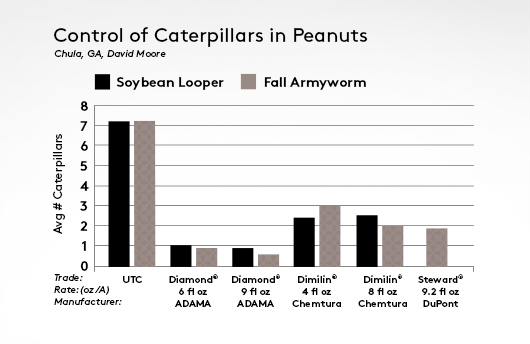
- Application timing: Target early intervention and population suppression. In cotton plant bug programs, prioritize late squaring through early flower; for peanuts, two 6 fl oz/a applications at 14-day intervals for extended caterpillar protection.
- Dosage guidance: Use rates vary by crop, pest, and pressure. Go-to rate for all crops would be 9 fl oz/A. A second application is warranted in situations with heavy pest pressure or migration into the field.
- Environmental considerations: Use optimum nozzle selection, carrier volume, spray coverage, and timeliness. Rotate insecticide classes and follow thresholds to support resistance management and avoid unnecessary applications.
Technical Specifications:
- Chemical group: Benzoylurea insect growth regulator; chitin synthesis inhibitor.
- IRAC classification: Group 15.
- Formulation: Emulsifiable concentrate.
- Packaging sizes: 2.5-gallon jug
- 9.3% novaluron / 0.83 lbs ai per gallon
Safety & Compliance
- Regulatory classification: Not restricted use. Always verify the current federal and state label before sale, recommendation, or application.
- Restricted-entry interval: Do not enter or allow worker entry into treated areas during the 12-hour REI.
- Early-entry PPE: Coveralls over long-sleeved shirt and long pants; chemical-resistant gloves such as barrier laminate, butyl rubber >=14 mils, nitrile rubber >=14 mils, neoprene rubber >=14 mils, or Viton >=14 mils; shoes plus socks; protective eyewear.
- Environmental warnings: Consult the current product label for aquatic, pollinator, drift, runoff, and endangered species restrictions.
- Storage and disposal: Follow label directions for pesticide storage, container handling, rinsing, recycling, and disposal.
FAQs:
Q: What is Diamond insecticide used for?
A: Diamond is used for immature insect control in crops such as cotton, peanuts, sorghum, soybeans, sugarcane, and sunflower, targeting plant bugs, stink bug nymphs, caterpillars, and other foliage-feeding pests.
Q: What is the active ingredient in Diamond?
A: The active ingredient in Diamond is novaluron.
Q: What group insecticide is Diamond?
A: Diamond is a Group 15 insecticide growth regulator and chitin synthesis inhibitor.
Q: Does Diamond kill adult plant bugs?
A: Diamond is not positioned for adult control. For adult plant bug pressure, use an appropriate tank-mix adulticide according to label directions and local recommendations.
Q: When should Diamond be applied in cotton?
A: For plant bug management in cotton, late squaring through early flower is the key timing window, especially when adults are migrating into the field.
Q: Is Diamond IPM friendly or soft on beneficial insects?
A: Diamond is moderate on beneficials and compatible with IPM programs when used according to label directions.
Q: What are common farmer synonyms for Diamond insecticide?
A: Common search terms may include Diamond IGR, novaluron insecticide, plant bug insecticide, cotton pest control, caterpillar control, Lygus control, and stink bug nymph control.
Key Target Details
Cotton
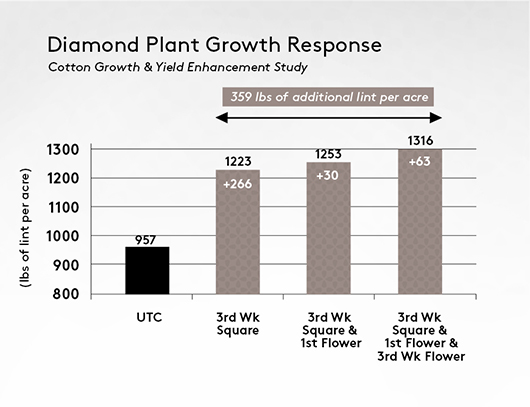
The average application for Diamond insecticide will pay for itself with fewer than 15 additional lbs of cotton… even in the absence of insect pressure.
Credit: Diamond application rate: 6 ounces. MSU. 2015.
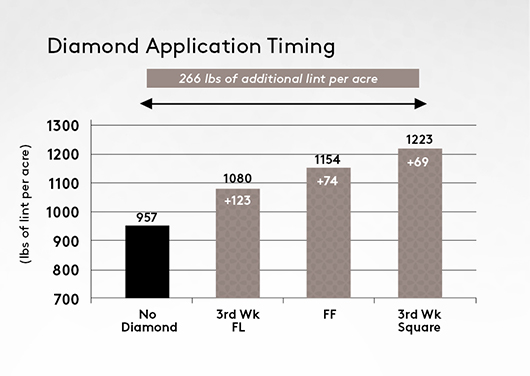
This graph shows different application timings with a single application of Diamond. From left to right, the bars represent no Diamond, third week of flowering, first flower, and third week of squaring. A single application of Diamond at anytime during the season resulted in a 123 lb increase in lint yield. When the application was made during the late squaring period, there was a 266 lb increase in lint yield. This corresponded to adults migrating into the cotton from corn.
Credit: JeffGore, Angus Catchot, Don Cook, and Fred Musser. MSU. 2015.
Sorghum
Sugarcane
Peanuts
Soybeans
Related Products

Cotoran® 4L

Temper™ More

Klean-Pik® 500SC
