

Controlling Wild Oats with TOPIK®
This resistance poses a significant risk to the yield and profitability of wheat crops, especially as just one wild oat plant per m2 is capable of reducing cereal yields by as much as 1 t/ha.
Thankfully, resistance is developing at a relatively slow rate, but it remains important to reduce the threat of further slippage by using a rotation of herbicide modes of action including ACCase inhibitors (clodinafop and cycloxydim, fenoxaprop and pinoxaden) and ALS inhibitors (mesosulfuron).
Species identification
The first step towards successful control is to confirm which species of wild oats is present, and to understand how and when the different species express peak emergence. This isn’t always that simple however, as distinguishing between the two species is difficult during early growth stages as common and sterile oats look almost identical until their panicles have emerged.
Common or spring wild-oat (Avena fatua)
- Prevalent throughout England. Found sporadically in Scotland and Wales
- 55% overall UK coverage
- Germinates mainly in the spring (March/April) but with a variable and sometimes considerable amount of autumn germination (September/October)
Winter wild-oat (Avena sterilis ssp. ludoviciana)
- Less common and mainly found within 50-100 miles of Oxford where it was first recorded in the wild in 1910
- 10% overall UK coverage
- Probably under-reported due to confusion with Avena fatua
- Germinates mainly in the autumn and winter (from October to early March) and is more tolerant of freezing conditions than Avena fatua.
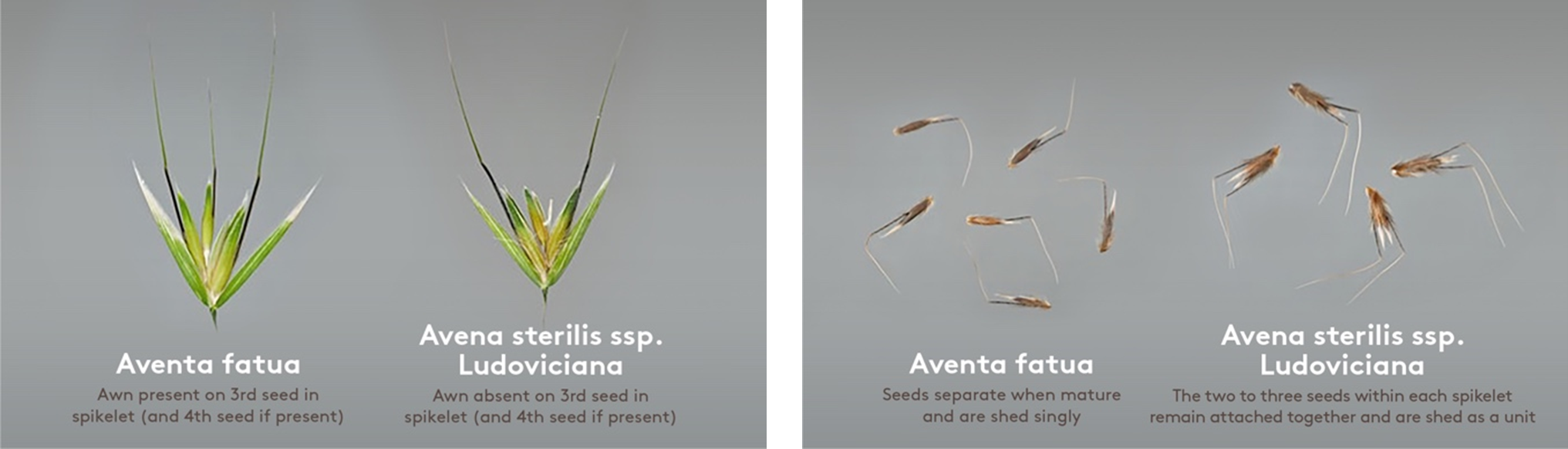
It is possible to distinguish between the two species of wild oat either by comparing panicles or seeds.
Timing is key
On land with a heavy wild oat burden, the first herbicide application of the season should be made as soon as conditions are conducive to effective herbicide performance: if using a clodinafop-based herbicide such as TOPIK® (240 g/L clodinafop-propargyl & 60 g/L cloquintocet-mexyl) the latest practical timing for application is at GS41. Beyond this the crop canopy may have developed to such an extent that it prevents effective coverage of the target weeds.
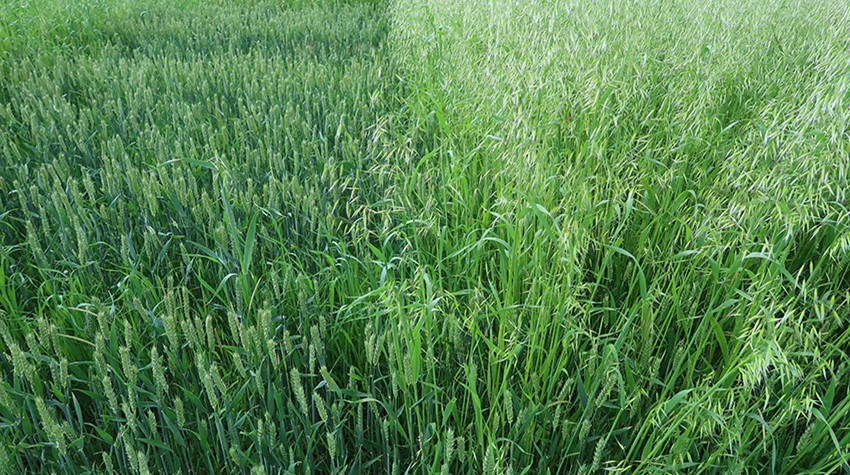
The power of TOPIK: treated (left) vs. untreated (right).
Best practice
To achieve the best results, TOPIK® must be used with care to ensure complete spray coverage is achieved: busy spraying schedules can make it tempting use a reduced water volume so that more ground can be covered within a specific window of opportunity. This is a feasible strategy when weeds are still small and not shielded by the crop canopy, but it is a poor technique to use later in the season when the crop is bigger.
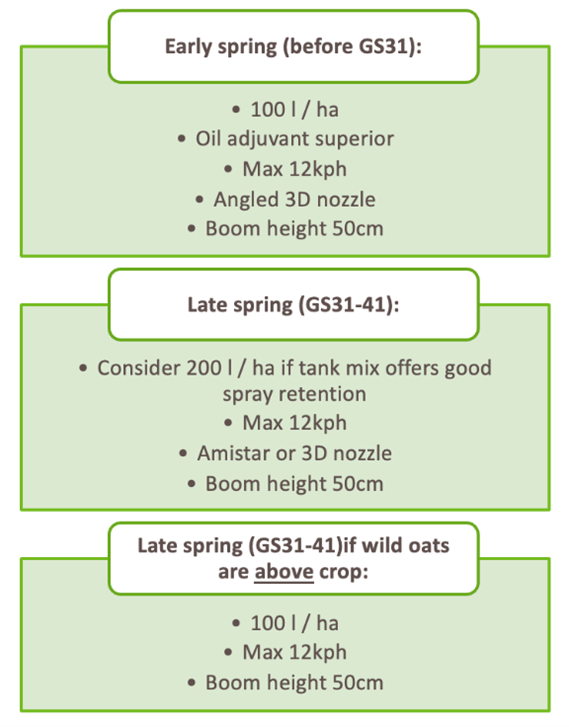
As a rule of thumb, it is possible to reduce water volume prior to GS31 (using 100l/ha instead of 200l/ha), but beyond this growth stage it is advised that a water volume of at least 200l/ha should be used. There is however some evidence to suggest that smaller droplets and a concentrated solution using 100l/ha will perform well at the GS31-41 timing, but only if the wild oat plants are larger than the crop and therefore emerging above the crop canopy.
Irrespective of when it is applied, TOPIK® will perform best when used during good growing conditions for the target weed as this improves product uptake. In contrast, cold and dry conditions will impede the efficacy of all ACCase herbicides, even when applied at the optimum timing for wild-oat activity.
Spraying tips
Nozzle choice, boom height and forward operating speed all effect spray coverage, as do nozzle choice and angle. The simple advice when spraying for wild oats is to:
- Spray slowly (maximum 12pkh)
- Spray at a sensible boom height (50cm above the canopy)
- Use an appropriate water volume (200l/ha after GS31)
- Select a nozzle type and angle to target weeds beneath the crop canopy.
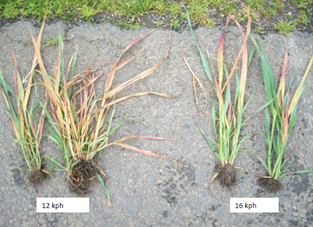
Reducing sprayer forward speed from 16kph down to 12kph is just one of the considerations needed to maximise wild oat control. Water volume, boom height and nozzle choice are also key factors, especially when tackling weeds protected by a thick crop canopy.
(Photo credit: Syngenta forward speed trial on TOPIK)
TOPIK®: growth stage application recommendations
TOPIK® (240 g/L clodinafop-propargyl and 60 g/L cloquintocet-mexyl)
Controls wild oats, rough meadow-grass and gives moderate control of Italian rye-grass in wheat, durum wheat and triticale.
Optimum timing:
Wild-oats from 1 leaf unfolded up to flag leaf ligule visible.
Application rates:
0.25//ha
0.125//ha plus a suitable adjuvant (e.g. methylated seed oil)
Optimum weed control is best achieved when all the wild-oats have emerged and are actively growing in good conditions. More information here.