
Multi-faceted T2 tank mix essential to protect wheat flag leaf
“The T2 fungicide timing is the most critical treatment for the protection of wheat crops as its application at GS37-39 provides the ideal opportunity to ensure the main light capturing leaves – leaf 2 and the newly emerged flag leaf – remain clean and free of the dominant yield-robbing diseases, Septoria tritici and rusts,” David explains.
“Even though weather conditions have been relatively favourable in recent weeks, there is still plenty of both diseases present in crops,” David adds. “Any disease spores sitting in the lower canopy could easily be transmitted onto the upper two leaves during heavy rainfall events, so a robust fungicide treatment is a must to keep both leaves as clean and green for as long as possible.”
David explains that a ‘robust’ fungicide treatment will contain a mixture of active ingredients, including single site and multi-site modes of action.
“The inclusion of an azole and/or an SDHI/Qil fungicide will provide a certain amount of curative activity, but because they only work against one biochemical pathway within their target pathogen, these single site chemistries are more prone to sensitivity shifts or mutations which make septoria populations resistant and therefore harder to control.
“A T2 treatment based solely on single site actives won’t therefore be enough to keep crops protected as they progress towards maturity. For that reason, a multi-site fungicide such as ARIZONA® (500g/l folpet) should be included to provide greater longevity of protection,” David says.
Including ARIZONA® at the T2 timing provides an additional, cost-effective layer of protection, with seven years of independent trials showing that its inclusion boosts yield by an average of 0.14t/ha across dry and wet seasons.
“With septoria inoculum levels in the base of crops high, but the top leaves largely clean due to the recent dry spell, the inclusion of a contact protectant fungicide such as ARIZONA® is a no brainer, especially as it is the only fungicide which has been proven to extend the effective lifetime of single site fungicides by delaying and reducing their susceptibility to resistance,” David states. “Adding ARIZONA® to the tank mix can also help to enhance the efficacy of single site chemistries, resulting in better yields at harvest.”
David continues to explain that ARIZONA® also provides a useful reduction of yellow and brown rusts, with trials indicating that its inclusion at T2 improves harvested yield by an average of 0.9t/ha where yellow rust is the main disease pressure.
“To achieve the very best levels of disease control in wheat, ARIZONA® should be used throughout the spring at T1 and T2,” David concludes. “However, even if it wasn’t applied at T1, including ARIZONA® at the T2 timing will still provide a clear advantage, especially as it does not interfere with the uptake of partner products, therefore enabling single site actives to provide curative control of any latent or active septoria infections.”
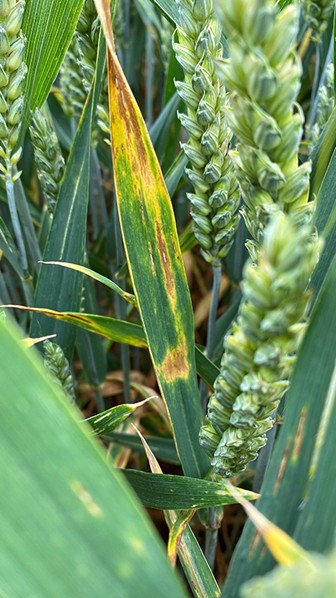
(Source: ADAMA UK) A robust T2 spray should be applied to protect the flag leaf and leaf 2 from any septoria spores that spread upwards from the lower canopy.


